
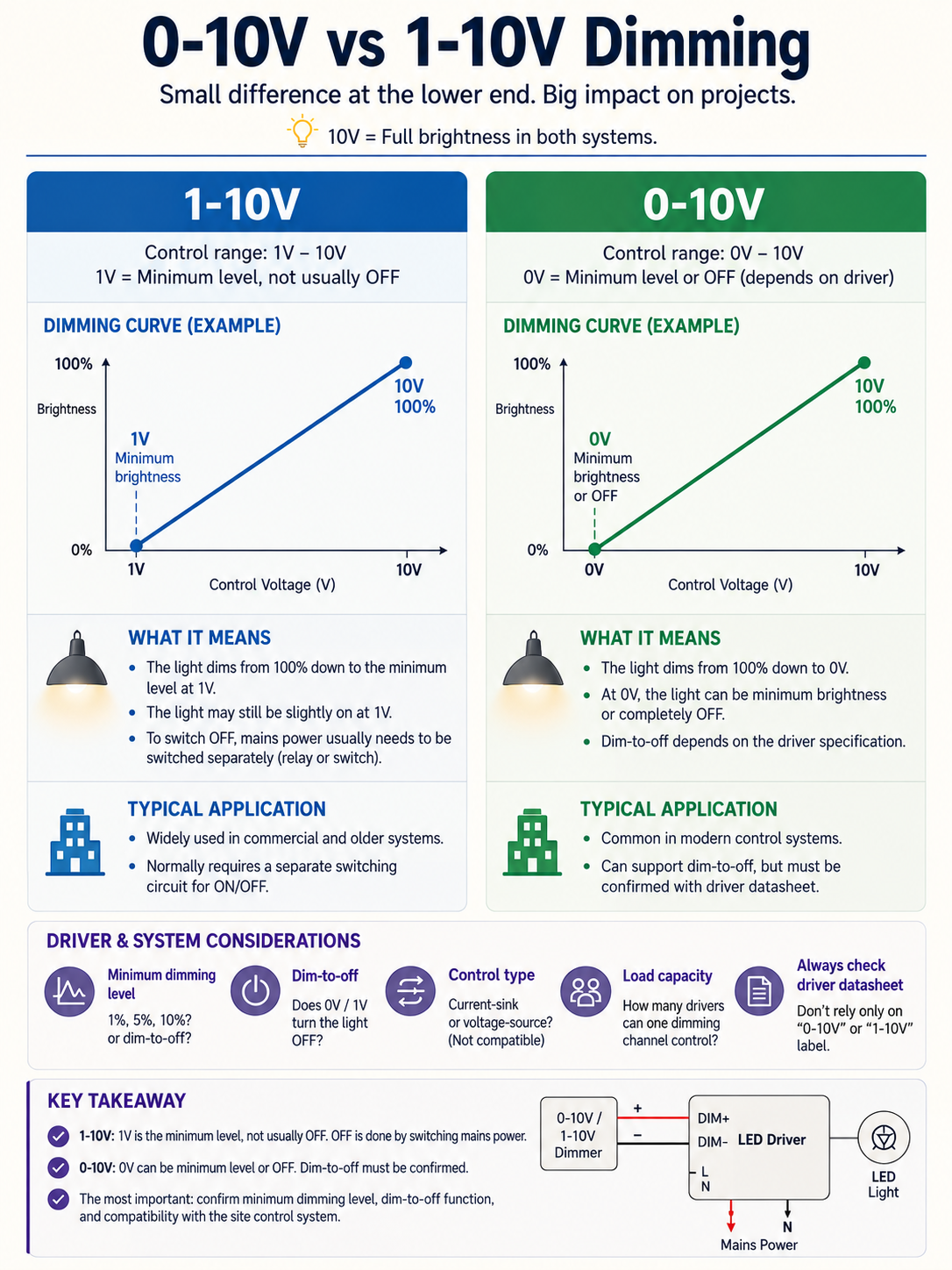
0–10V and 1–10V dimming are often written together, but they are not exactly the same.
For decorative lighting projects, especially in hotels or commercial interiors, this small difference can affect the final dimming performance on site.
The basic idea
The basic idea is simple:
10V usually means full brightness.
The difference is at the lower end.
1–10V dimming
With 1–10V, the control range is normally from 10V down to 1V. At 1V, the driver usually reaches its minimum dimming level, but the light may not switch off completely.
So if the project requires the fixture to turn off, the mains power normally needs to be switched separately.
0–10V dimming
With 0–10V, the control range can go down to 0V. In some drivers, 0V means the light can dim down to off.
But this is not always guaranteed.
Some 0–10V drivers still only dim down to 1%, 5% or 10%, and the fixture will not fully turn off unless the mains power is also switched.
What should be checked?
This is why, when selecting a driver, I do not only check whether it says “0–10V dimmable”.
I usually check a few more details:
- What is the minimum dimming level?
- Does the driver support dim-to-off?
- Does the site control system use 0–10V or 1–10V?
- Is the control type current-sink or voltage-source?
- How many drivers will be connected to one dimming channel?
Why this matters in decorative lighting projects
For small decorative fixtures, wall lights, reading lights, pendants or bespoke fittings, the driver is often hidden remotely or inside a small canopy.
If the dimming type is not confirmed clearly at the beginning, the problem may only appear after installation.
At that stage, changing the driver, rewiring the control line or adding a relay can become much more difficult.
So for project lighting, “dimmable” is not always enough as a specification.
A better question is:
How exactly does it dim, and how exactly does it switch off?