
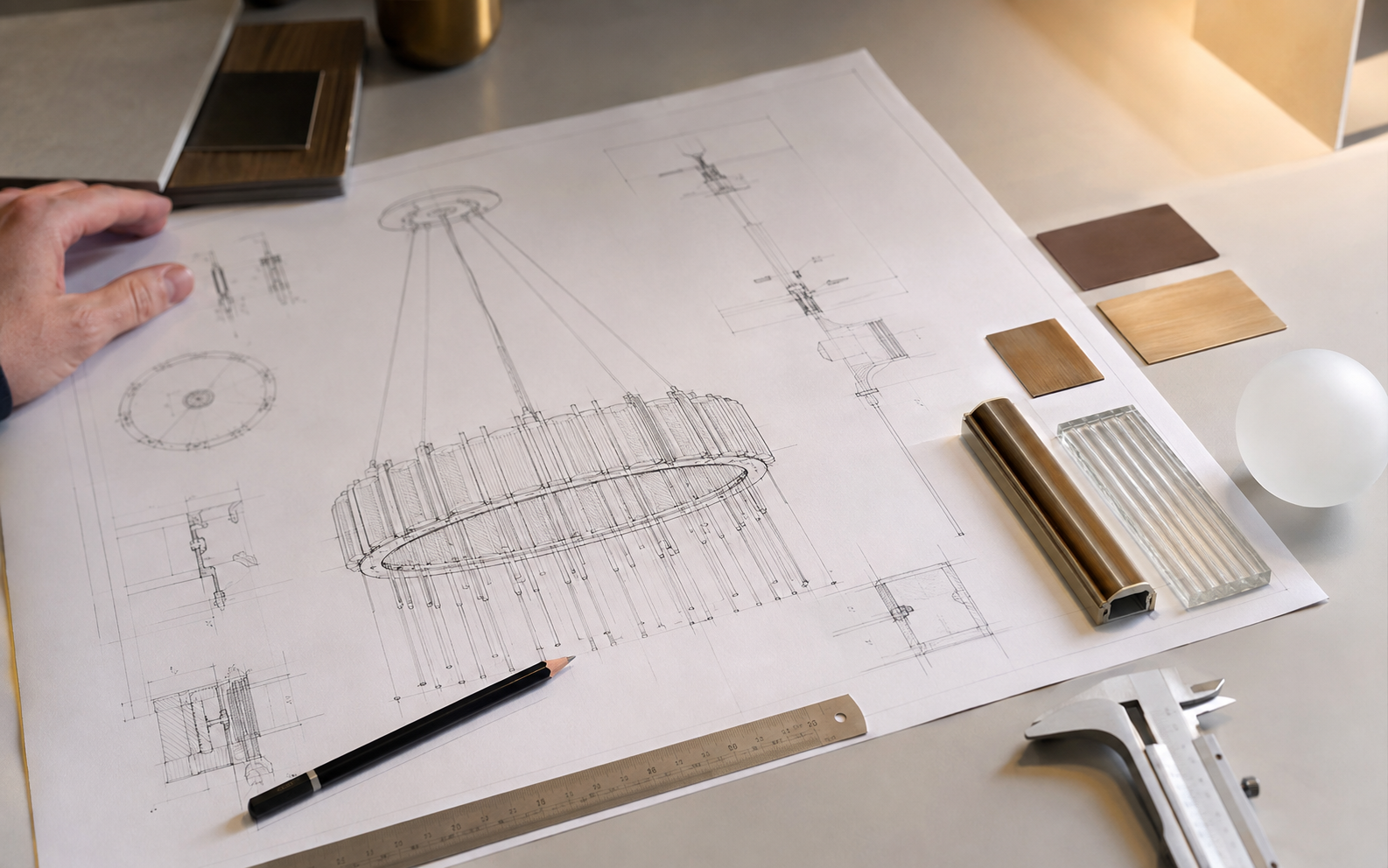
Bespoke lighting is developed in response to a particular interior, rather than selected as a finished product from a catalogue.
Its proportions may relate to the architecture. Its materials and finishes may coordinate with surrounding joinery, metalwork or furniture. Its light output, controls and installation details may also need to respond to specific technical conditions within the project.
Some projects require a completely original lighting fixture, while others begin with an existing design that is adapted in scale, finish, configuration or performance.
The purpose is the same: to create lighting that belongs to the space and can be manufactured and installed.
Bespoke lighting is more than a change of finish
The word bespoke is sometimes used for relatively simple product variations. Changing a metal finish or adjusting the length of a pendant may be sufficient for one project, but more involved schemes require a wider level of coordination.
A bespoke decorative lighting fixture may include changes to:
- Overall dimensions and proportions
- Materials and decorative finishes
- Glass colour and texture
- Number and arrangement of lighting elements
- Suspension height and ceiling fixing
- Light source and colour temperature
- Light output and distribution
- Dimming and control requirements
- Driver location and accessibility
- Mounting details and electrical connections
- Weight, structural support and installation method
These decisions are connected. Increasing the diameter of a chandelier, for example, may affect its weight, supporting frame, suspension system, power requirements, packaging and method of installation.
A successful result therefore depends on considering the fixture as a complete product rather than a collection of visual choices.
Bespoke and customised lighting are not always the same
There is a useful distinction between a fully bespoke product and a customised version of an existing design.
A fully bespoke luminaire is developed specifically for the project. Its form, construction and technical arrangement may all be original.
A customised product begins with an existing design direction or construction principle. Selected elements—such as scale, finish, glass, suspension or light source—are then adjusted to suit the interior.
The appropriate route depends on the design intent, quantity, project conditions, budget and level of technical development required.
For a guestroom, adapting an established wall-light structure may provide the most practical solution. A large chandelier for a lobby, staircase or destination restaurant may require a completely project-specific frame, suspension arrangement and lighting configuration.
When is bespoke lighting appropriate?
Bespoke lighting is particularly valuable when a standard product cannot respond adequately to the scale, character or installation conditions of the space.
This is often the case in:
- Hotel lobbies and reception areas
- Restaurants, bars and private dining rooms
- Guestrooms and suites
- Staircases and multi-level spaces
- Corridors and lift lobbies
- Feature walls and decorative niches
- Entrances, terraces and landscaped areas
- Interiors with coordinated furniture or joinery packages
The requirement may be primarily visual, but it may also be practical.
A ceiling void may offer limited space for drivers and fixings. A bedside light may need to align precisely with a headboard panel. A large chandelier may require several structural suspension points. An exterior fitting may need suitable material protection and an appropriate IP rating.
These conditions are easier to resolve when they are identified at the beginning of development.
What information is needed to begin?
A project does not need to be fully resolved before lighting development can start.
Initial information may include:
- Drawings or marked-up plans
- Key dimensions
- Reference images or sketches
- Intended installation location
- Approximate quantities
- Preferred materials and finishes
- Required colour temperature
- Dimming or control requirements
- Relevant ceiling, wall or electrical conditions
Reference images are useful for communicating atmosphere, proportion and material direction. They should not be treated as complete technical specifications.
Two lighting fixtures that appear similar in an image may have very different internal structures, lighting performance and installation requirements. The reference establishes the design intention; further development determines how it can be produced for the actual project.
From design intent to production
The development process varies according to the product, but it normally moves through several coordinated stages.
1. Initial review
The available information is reviewed to understand the visual intention, approximate scale, application and technical requirements.
At this stage, it is important to identify missing information and any conditions that may affect feasibility or cost.
2. Product development
The design is translated into a manufacturable structure.
This may involve reviewing material thicknesses, internal supports, glass fixing, access to light sources, driver locations, suspension points and the relationship between decorative and electrical components.
The aim is not simply to reproduce the appearance of a reference image. The product must also be stable, serviceable and suitable for installation.
3. Drawings and technical coordination
Shop drawings establish the proposed dimensions, construction, fixing method and principal components.
They provide a basis for coordinated review between the lighting manufacturer, designer, contractor and other relevant parties.
For larger or more complex lighting fixtures, drawings may also need to show suspension positions, ceiling interfaces, cable routes, remote drivers and assembly sequences.
4. Materials and finish samples
A finish is affected by the base material, surface preparation, application method, texture and level of sheen. A written description such as “antique brass” is rarely sufficient on its own.
Physical samples help the project team see how the product will actually look.
Glass may also require a sample when colour, texture or the character of hand-blown variation is important to the design.
5. Sample review
A sample allows the design and construction to be reviewed before production.
Depending on the product, the review may include:
- Overall proportion
- Material appearance
- Finish consistency
- Glass fit and support
- Stability and adjustment
- Switching and dimming
- Light colour and distribution
- Assembly and installation details
A sample is especially valuable when the design contains a new mechanical detail, a custom glass component or a particular relationship with surrounding furniture or architecture.
6. Production and final review
Once the relevant details are approved, the product can move into production.
Final dimensions, materials, finishes, light sources and installation arrangements should correspond with the approved information. Complex products may also require staged assembly checks, lighting tests or pre-dispatch inspection.
The technical details matter
Decorative lighting is highly visible, but many of the decisions that determine its success are hidden.
A driver must be suitable for the LED load and control system. It must also be positioned where it can be accessed in the future.
A ceiling fixing must support the lighting fixture safely and correspond with the structure available on site.
A decorative metal finish must be achievable across the selected base materials and components. If different metals are used within the same product, their finished appearance may not be identical.
A reading light must provide useful illumination in the correct position without creating uncomfortable glare.
A large chandelier must be considered not only as a visual object but also as a product that needs to be transported, assembled, suspended, wired and maintained.
Resolving these points does not reduce the creative intent. It allows that intent to survive the transition from drawing to complete product.
Why early coordination is valuable
Changes become more difficult once materials have been ordered, glass has been produced or fixing points have been prepared on site.
Early technical review can identify questions such as:
- Is the proposed scale appropriate for the space?
- Can the ceiling support the required weight?
- Where will the drivers be located?
- How will the product be assembled and installed?
- Can the light source be accessed for maintenance?
- Is the specified control system compatible?
- Will the proposed finish behave consistently across all components?
Not every detail needs to be decided immediately. The key point is to establish which decisions affect other parts of the product and when they must be confirmed.
A coordinated product for an individual interior
Bespoke lighting works best when design intent, technical performance and installation conditions are considered together from the beginning.
The result should not only look appropriate within the interior. It should also be practical to manufacture, clear to approve and properly resolved for installation.
At Covetstar, bespoke decorative lighting is developed in coordination with the information available for each project—from initial references and drawings through to materials, technical details and production.
Dimensions, drawings or reference images can provide a useful starting point for an initial project review.