
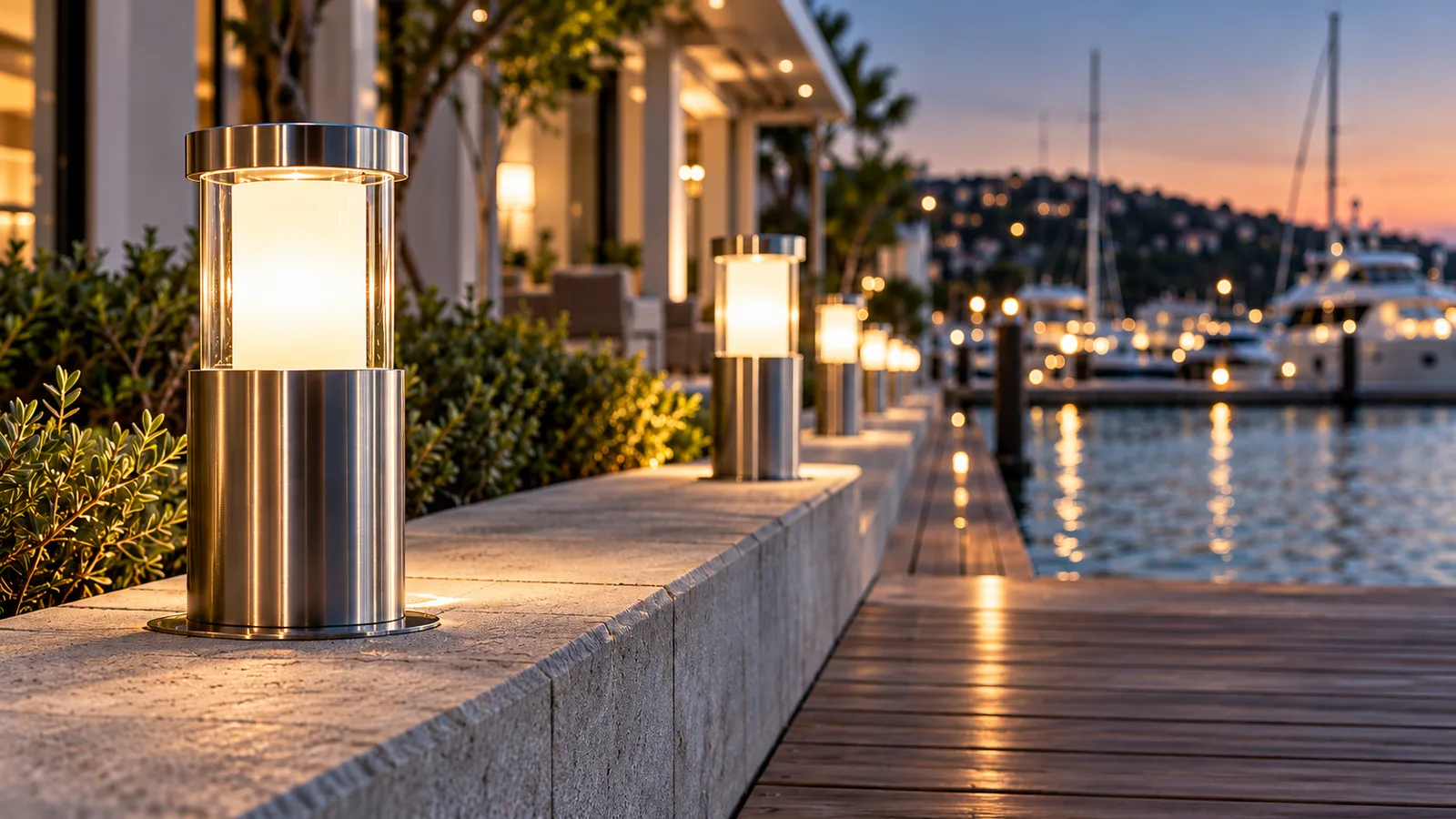
When selecting materials for outdoor decorative lighting, stainless steel 304 and 316 are two commonly considered options.
For landscape lighting, architectural lighting, waterfront developments and marina projects, 316 stainless steel is often specified because of its higher corrosion resistance.
But does every outdoor lighting fixture near the sea really need 316?
Not necessarily.
The appropriate stainless steel grade depends on the actual installation environment, exposure to saltwater, structural requirements, surface treatment and long-term maintenance conditions.
Understanding these differences helps avoid both unnecessary material costs and premature corrosion.
What Is the Difference Between Stainless Steel 304 and 316?
Both 304 and 316 belong to the austenitic stainless steel family. They offer good mechanical properties, fabrication characteristics and corrosion resistance.
The main difference lies in their chemical composition.
304 stainless steel typically contains approximately 18% chromium and 8% nickel.
316 stainless steel contains chromium and nickel, together with approximately 2–3% molybdenum. Exact composition limits depend on the specified grade and product standard.
The addition of molybdenum improves resistance to chloride-induced pitting and crevice corrosion.
| Property | Stainless Steel 304 | Stainless Steel 316 |
|---|---|---|
| General corrosion resistance | Good | Very good |
| Chloride resistance | Moderate | Higher |
| Outdoor applications | Widely used | Widely used |
| Coastal environments | Suitable under selected conditions | Generally preferred |
| Direct seawater exposure | Generally unsuitable | Requires careful engineering evaluation |
| Material cost | Generally lower | Generally higher |
| Fabrication availability | Widely available | Available; some forms may require additional sourcing |
These are qualitative comparisons, not corrosion ratings or guarantees of service life.
The important point is that 316 offers greater corrosion resistance, but the additional performance is not necessarily required for every outdoor installation.
Outdoor Lighting Is Not the Same as Underwater Lighting
One common mistake in material selection is treating all marine-related environments as identical.
There is a significant difference between a decorative lighting fixture installed near the coast and a metal component continuously exposed to seawater.
Consider three different installation conditions.
| Exposure | Main consideration | Material-selection starting point |
|---|---|---|
| General outdoor atmosphere | Rain, pollution and cleaning access | 304 may be sufficient where salt exposure is low |
| Coastal atmosphere | Airborne chlorides and persistent deposits | Generally consider 316/316L; assess any proposed use of 304 carefully |
| Marine splash or seawater contact | Concentrated salt, wet crevices and immersion | Assess 316L or higher-alloy options; a site-specific review is essential |
General Outdoor Landscape Lighting
For hotel gardens, terraces, commercial developments and outdoor architectural installations away from significant salt exposure, 304 stainless steel can be a practical and cost-effective solution.
Coastal Decorative Lighting
For lighting installed near the sea but protected from direct seawater contact, 304 may be considered depending on airborne salt concentration, surface finish, cleaning accessibility and expected service life.
However, installations exposed to persistent salt spray, high humidity and limited cleaning generally benefit from 316 or a more corrosion-resistant material.
Marina and Marine-Contact Lighting
For lighting posts exposed to frequent marine salt deposits or intermittent seawater splashes, 316L is generally a more appropriate starting point than 304, subject to an exposure assessment. Tidal immersion or sustained seawater contact requires a separate corrosion engineering evaluation; neither 316 nor 316L should be assumed adequate by default.
Even 316L may require further evaluation where seawater becomes trapped in joints or crevices.
Proximity to the sea alone does not determine the material grade. Actual exposure conditions do.
Why 304 Can Be Sufficient for Some Outdoor Lighting Projects
304 stainless steel is widely used in architectural and decorative lighting because it offers a useful combination of corrosion resistance, strength, manufacturability and cost.
Reliable Performance in Moderate Outdoor Conditions
304 provides good resistance to normal atmospheric corrosion and is suitable for many exterior architectural components.
Manufacturing Flexibility
304 stainless steel is readily available in standard sheet, tube and fabricated component forms, making it convenient for customised lighting production.
Cost Efficiency
Compared with 316, 304 is generally more economical, particularly when manufacturing multiple customised lighting fixtures.
Compatibility with Decorative Finishes
304 can be brushed, polished or prepared for various decorative surface finishes, depending on the project specification. Confirm the visual finish with a physical sample; our guide to specifying decorative metal finishes explains the approval principles.
However, protective coatings should not automatically be treated as substitutes for selecting a suitable stainless steel grade.
For coastal installations, the coating system itself must be evaluated for the expected exposure and service conditions.
When Should 316 Stainless Steel Be Specified?
316 or 316L should be strongly considered when the project involves:
- Outdoor lighting exposed to frequent marine salt spray
- Waterfront installations with persistent salt deposits
- High-humidity coastal locations with limited cleaning access
- Marine structures with direct splash exposure
- Components where corrosion could compromise structural safety or long-term reliability
316L is also commonly considered for welded components because its lower carbon content reduces the risk of sensitisation associated with welding. The low-carbon designation does not, by itself, provide a major increase in chloride pitting resistance over 316.
For particularly aggressive marine applications, higher-alloy stainless steels or alternative materials may be necessary.
Surface Treatment and Structural Design Also Matter
Selecting 316 does not automatically guarantee corrosion-free performance.
For bespoke outdoor lighting, material selection is only one part of the engineering process.
Surface Finishing
Smooth, properly finished stainless steel surfaces generally provide better resistance to the accumulation of contaminants than rough or damaged surfaces.
Welding and Fabrication
Welded areas should be properly cleaned and treated to remove heat tint and surface contamination. The finishing procedure must address weld oxides and any chromium-depleted surface layer; passivation alone should not be assumed to remove heat tint.
Water Drainage
Design details should prevent standing water and trapped salt deposits, especially inside joints and concealed structural connections.
Fasteners and Material Compatibility
Bolts, anchors and connections should be selected with consideration for galvanic corrosion, crevice corrosion and structural requirements.
Maintenance
Periodic freshwater cleaning can help remove salt deposits from accessible surfaces and reduce the risk of corrosion.
These considerations are particularly important for decorative lighting installed in challenging outdoor environments.
Choosing Materials for Bespoke Marina Lighting Posts
For decorative lighting posts used in waterfront developments or marina environments, it is useful to separate the product into individual functional components.
Depending on the design, a customised lighting post may include:
- Decorative plastic or glass exterior panels
- An internal metal support structure
- Rope passage assemblies and fastening components
- LED lighting modules and electrical connections
- A structural base and installation anchors
Each component may require a different material or protection strategy. Decorative rope passages must not be treated as mooring or safety-load attachments unless specifically engineered for those loads. Material grade selection also does not replace assessment of the fitting’s electrical safety and ingress protection.
For example, a decorative housing made from UV-resistant plastic does not necessarily require the same material specification as a load-bearing internal frame.
Likewise, concealed stainless steel components that remain dry may experience different corrosion conditions from exposed fasteners or rope connections.
However, concealed components are not automatically protected from corrosion. Moisture ingress, condensation and trapped salt must still be considered.
For this type of project, the most effective approach is to assess the exposure conditions and structural requirements before selecting the final material grade.
Our Approach to Material Selection
At Covetstar, we believe material selection should be based on actual project requirements rather than choosing the highest-grade material by default.
As part of our custom lighting manufacturing process, we consider:
- Installation environment and potential salt exposure
- Material availability and manufacturing feasibility
- Surface finishing and corrosion protection
- Structural design and installation requirements
- Budget, maintenance and expected service life
304 stainless steel may provide a suitable solution for many conventional outdoor applications.
Where exposure to marine salts is more aggressive, 316L or other corrosion-resistant materials may be required.
The objective is not simply to choose between 304 and 316, but to select a material and construction method that deliver reliable performance in the intended environment.
For bespoke hotel lighting, landscape lighting and architectural lighting projects, early material assessment can help improve durability, control manufacturing costs and reduce complications during production and installation.
Project teams can discuss exposure conditions and material requirements before the construction details are finalised.
Technical References
- British Stainless Steel Association — Selection of 316, 304 and 303 types of stainless steels for seawater applications: limits of seawater service, crevices, drainage and welded structures.
- British Stainless Steel Association — Stainless Steels to Behold: 316/L: composition, molybdenum and applications.
- Nickel Institute — Stainless Steels in Architecture, Building and Construction: Guidelines for Corrosion Prevention: atmospheric exposure, grade selection, design and maintenance.