
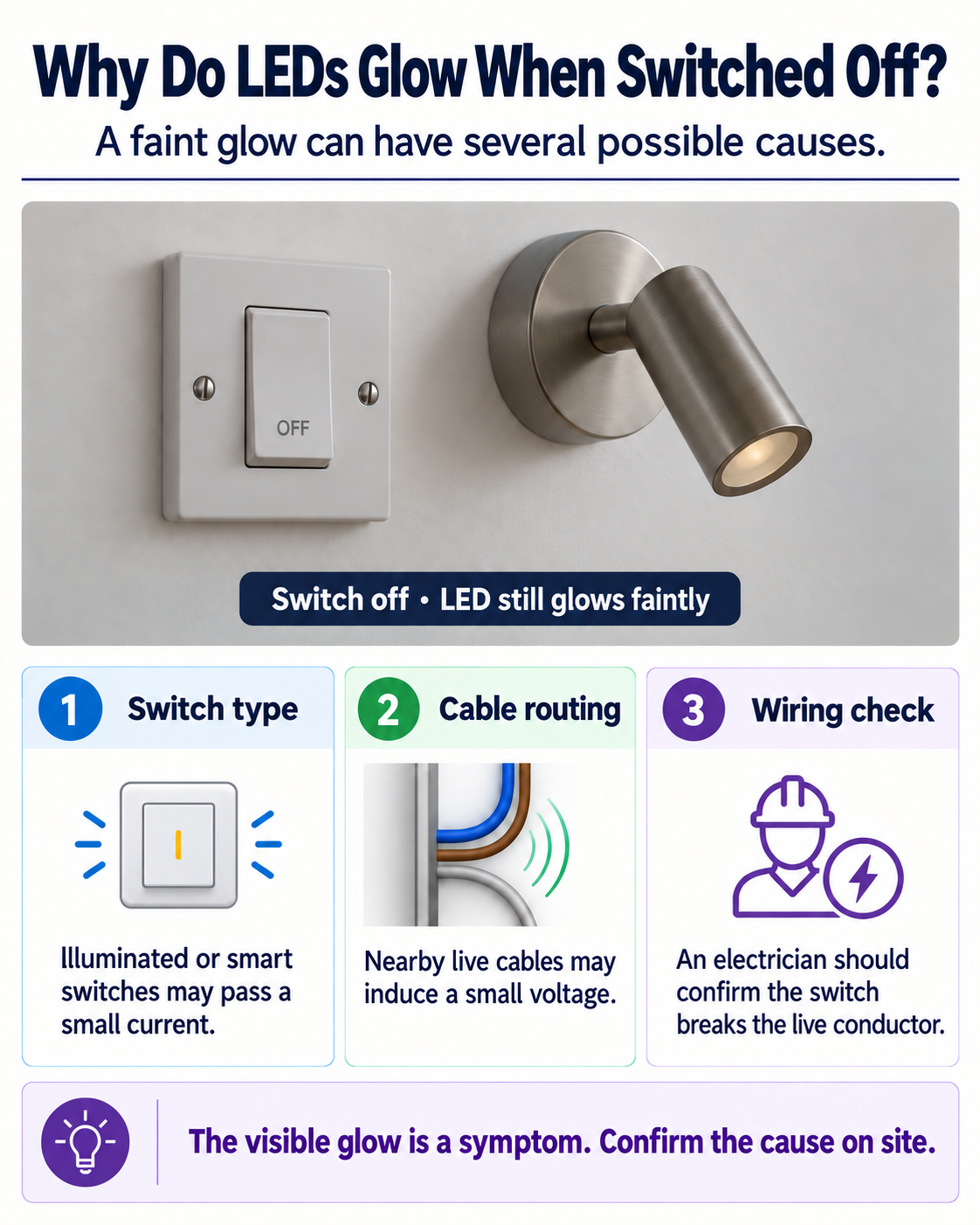
A wall switch is off, but the LED light still has a faint glow. This can be especially noticeable in a dark hotel bedroom, where even a small amount of light may disturb the intended lighting scene.
The glow does not automatically mean the LED or driver is faulty. The switch, wiring and driver need to be considered together.
First, what has been switched off?
Turning off a wall switch is different from isolating the electrical circuit. Depending on the type of switch and how the circuit is wired, a small amount of electrical energy may still reach the LED driver.
An LED needs very little energy to produce visible light. That is why a small electrical effect that went unnoticed with an older lamp may become visible with an LED fitting.
Three possible causes
1. The switch allows a small current to pass
Some illuminated switches use a small current to keep their indicator lit. Certain smart switches and electronic controls can also allow a small current to pass when they appear to be off.
That current may be enough to make a sensitive LED glow faintly. The switch type is therefore one of the first things to check.
2. The cable runs close to other live cables
Where cables run alongside live cables, the switched cable may pick up a small amount of electrical energy through capacitive coupling.
Depending on the cable arrangement and the driver, this may cause a faint glow or occasional flashing. The site wiring must be checked before drawing a conclusion.
3. The switch may be connected incorrectly
A single-pole switch should interrupt the live conductor. If it interrupts the neutral instead, the fitting may remain live even though the light appears to be off.
This is a wiring and safety issue that a qualified electrician should check and correct. It should not be assumed to be the cause of the glow without testing.
How should the issue be checked?
Start by confirming the type of switch or control installed. Is it a simple mechanical on/off switch, an illuminated switch, a smart switch, or part of a wider lighting control system?
A qualified electrician can then check how the switch is connected, review the cable routing and test the supply at the driver using appropriate equipment. The results need to be interpreted in the context of the complete circuit.
It also helps to observe how the light behaves. A brief glow that fades after switching off is different from a faint glow that continues or repeats.
Why this matters in project lighting
A small afterglow may be particularly visible on a bedside reading light, wall light or other decorative fitting in a dark interior.
When specifying these fixtures, “non-dimmable” or “on/off” describes the intended operation of the light. The final result also depends on the switch and site wiring.
If a light glows after the switch is turned off, the practical question is:
What is reaching the driver when the switch is off?
Once that is confirmed on site, the appropriate solution can be chosen.