
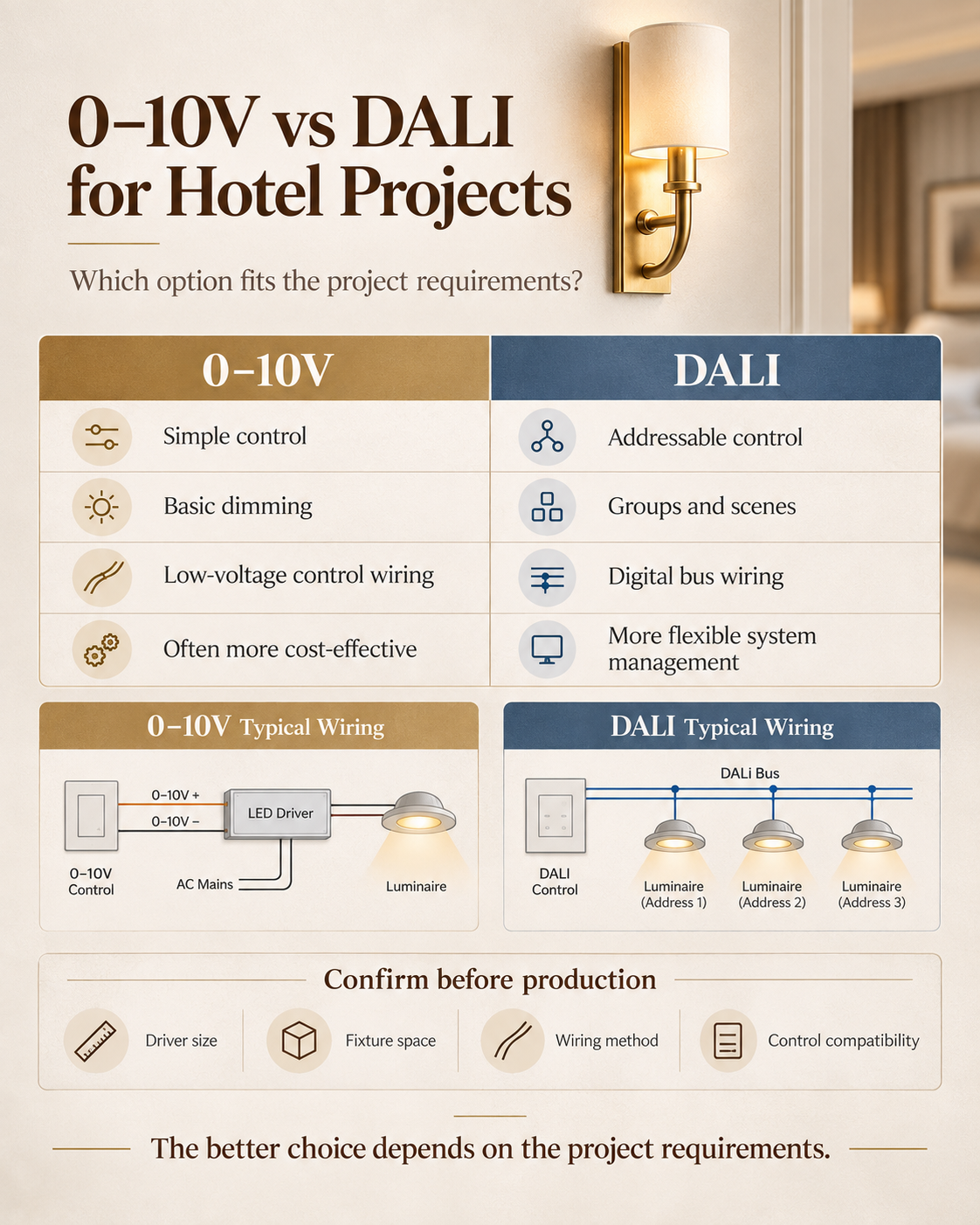
For bespoke hotel lighting projects, choosing a dimming system is not only about adjusting the light level.
The decision can also affect driver selection, control wiring, installation planning, commissioning, maintenance and even the physical construction of the lighting fixture.
Two common options are 0–10V and DALI.
Both can provide dimming, but they operate differently and are suited to different project requirements. The better choice is not determined by which system is more advanced. It depends on what the hotel actually needs.
What is 0–10V dimming?
0–10V is an analogue lighting-control method.
A compatible controller sends a low-voltage control signal to the LED driver. The driver adjusts its output according to that signal.
In many projects, several drivers connected to the same control channel dim together. This makes 0–10V suitable for areas where simple and coordinated dimming is required without individual control of every fitting.
Typical applications may include:
- Guest-room decorative lighting
- Corridors
- Restaurants
- Back-of-house areas
- Groups of pendants or wall lights
- Areas requiring straightforward dimming control
The system can be practical and comparatively cost-effective, provided the correct control wiring has been prepared on site.
What are the main advantages of 0–10V?
For projects with relatively simple dimming requirements, 0–10V can offer several advantages.
A comparatively simple control method
The control concept is straightforward. A compatible controller and driver are connected through the required analogue control wiring.
Suitable for grouped dimming
Several fittings can be controlled together when they are connected to the same dimming channel.
This may be sufficient for a hotel room, corridor or restaurant zone where all fittings within an area are intended to respond together.
Often more cost-effective
The equipment and commissioning requirements may be simpler than those of a fully addressable digital control system.
The actual cost still depends on the selected drivers, controllers, number of channels and overall project design.
What should be considered with 0–10V?
A 0–10V system still requires proper coordination.
The site must provide the correct low-voltage control wiring. The driver must be compatible with the controller, and the number of drivers connected to one control channel must remain within the controller’s permitted capacity.
The project team should also confirm:
- The minimum dimming level
- Whether dim-to-off is required
- How the fittings will switch off
- Whether the controller and driver use compatible interface behaviour
- How many drivers will be connected to each channel
- Whether 0–10V or 1–10V is specified
These details should not be assumed from the word “dimmable”.
What is DALI?
DALI stands for Digital Addressable Lighting Interface.
It is a digital lighting-control protocol that allows compatible control devices and LED drivers to communicate over a DALI bus.
Unlike a basic grouped analogue system, DALI allows drivers to be individually addressed. Individual fittings can then be assigned to groups, programmed into scenes and controlled as part of a wider lighting-management system.
This can be useful in hotels where the lighting design includes:
- Multiple operational scenes
- Individually controlled fixtures
- Flexible grouping
- Central management
- Integration with sensors or other controls
- More detailed commissioning requirements
DALI is therefore often selected for larger or more control-intensive hospitality projects.
What are the main advantages of DALI?
Individual addressable control
Compatible DALI drivers can be individually addressed within the system.
This allows the project team to control one fitting independently or assign multiple fittings to a group without necessarily changing the physical control wiring.
Scene setting
Different lighting scenes can be programmed for different uses or times of day.
In a hotel restaurant, for example, the lighting may need different settings for breakfast, afternoon service, evening dining and cleaning.
Flexible grouping
Fixtures can be grouped through system programming. This can provide more flexibility when the operational requirements change.
Digital communication
DALI uses digital communication between the control system and compatible devices.
Depending on the system and the functions supported by the selected equipment, this may also enable feedback, status information or additional diagnostic functions.
What should be considered with DALI?
DALI normally involves more system coordination than a simple analogue dimming arrangement.
The project requires appropriate DALI drivers, DALI bus wiring, control devices, a bus power supply and system commissioning.
The exact requirement should be confirmed before selecting the driver:
- Does the project require DALI or DALI-2?
- Is the proposed driver properly certified?
- Is it compatible with the site control system?
- How will the fittings be addressed and grouped?
- Who is responsible for commissioning?
- Has the required DALI bus wiring been installed?
- Will the driver be built into the fitting or installed remotely?
DALI should not be treated as a simple driver substitution made at the end of production.
0–10V vs DALI: a practical comparison
| Project consideration | 0–10V | DALI |
|---|---|---|
| Control method | Analogue control signal | Digital communication |
| Typical control | One channel controls a group of drivers | Individual addressing and programmable groups |
| Scene setting | Depends on the external controller | Supported through the DALI control system |
| Control wiring | Low-voltage analogue control pair | DALI bus |
| Driver requirement | Compatible 0–10V driver | Compatible DALI or DALI-2 driver |
| Commissioning | Often comparatively simple | Normally requires addressing and system commissioning |
| Project complexity | Suitable for straightforward dimming | Suitable for more detailed control requirements |
| Cost | Often lower for simple systems | Often higher due to controls and commissioning |
| Future changes | May require channel or wiring changes | Grouping and scenes can often be changed through programming |
This comparison describes typical project arrangements. The final design depends on the selected products and the complete control system.
Which system is better for a hotel project?
Neither system is automatically better for every project.
0–10V may be the practical choice when:
- The project requires straightforward dimming
- Groups of fittings will always operate together
- Individual addressing is not required
- The control strategy is relatively simple
- The required analogue control wiring has been prepared
- Cost and simplicity are important project considerations
DALI may be the stronger choice when:
- Individual fixtures need to be addressed
- Multiple lighting scenes are required
- The project needs flexible grouping
- Lighting is integrated into a wider hotel-control strategy
- The specification requires DALI or DALI-2
- More detailed commissioning and management are required
Centralized control alone does not necessarily determine the choice. A 0–10V system can also be operated through a central controller. The key difference is the level of addressing, communication, grouping and system flexibility required.
How does the decision affect bespoke lighting fixtures?
For bespoke decorative lighting, the dimming system can influence the fixture much earlier than expected.
The selected driver may affect:
- Driver dimensions
- Internal installation space
- Ceiling-canopy dimensions
- Backplate depth
- Ventilation and heat management
- The number of drivers required
- Cable entry positions
- Wiring methods
- Remote-driver locations
- Maintenance access
A DALI driver may have different dimensions from the originally proposed 0–10V driver. If it does not fit inside the fitting or canopy, the driver may need to be installed remotely.
This can then affect cable routing, installation access and the information shown on the shop drawing.
For a wall light with a shallow backplate, even a small difference in driver size can require a structural change. For a large chandelier using several drivers, changing the control system may affect the entire electrical arrangement.
Confirm the system before production
The dimming requirement should be reviewed before the production drawing is approved.
At minimum, the project team should confirm:
- The required control system
- Whether DALI or DALI-2 is specified
- Whether the system is 0–10V or 1–10V
- The exact driver model
- The number and location of drivers
- Available installation space
- Site-control wiring
- Minimum dimming performance
- Switching and dim-to-off requirements
- Commissioning responsibility
- Future maintenance access
Leaving these decisions until installation can result in driver replacement, canopy modification, rewiring or additional commissioning work.
The better choice depends on the project
If a hotel project only requires straightforward grouped dimming, 0–10V can be a practical and cost-effective solution.
If the project requires individual addressing, flexible grouping, programmed scenes and more detailed lighting management, DALI is often the stronger choice.
For bespoke lighting fixtures, this decision should never be treated as a minor technical detail.
The control method can affect the driver, wiring, installation space and physical fixture design long before manufacturing begins.
Confirming it early allows the fitting and the site-control system to be developed together—and helps avoid much larger problems during installation and commissioning.