
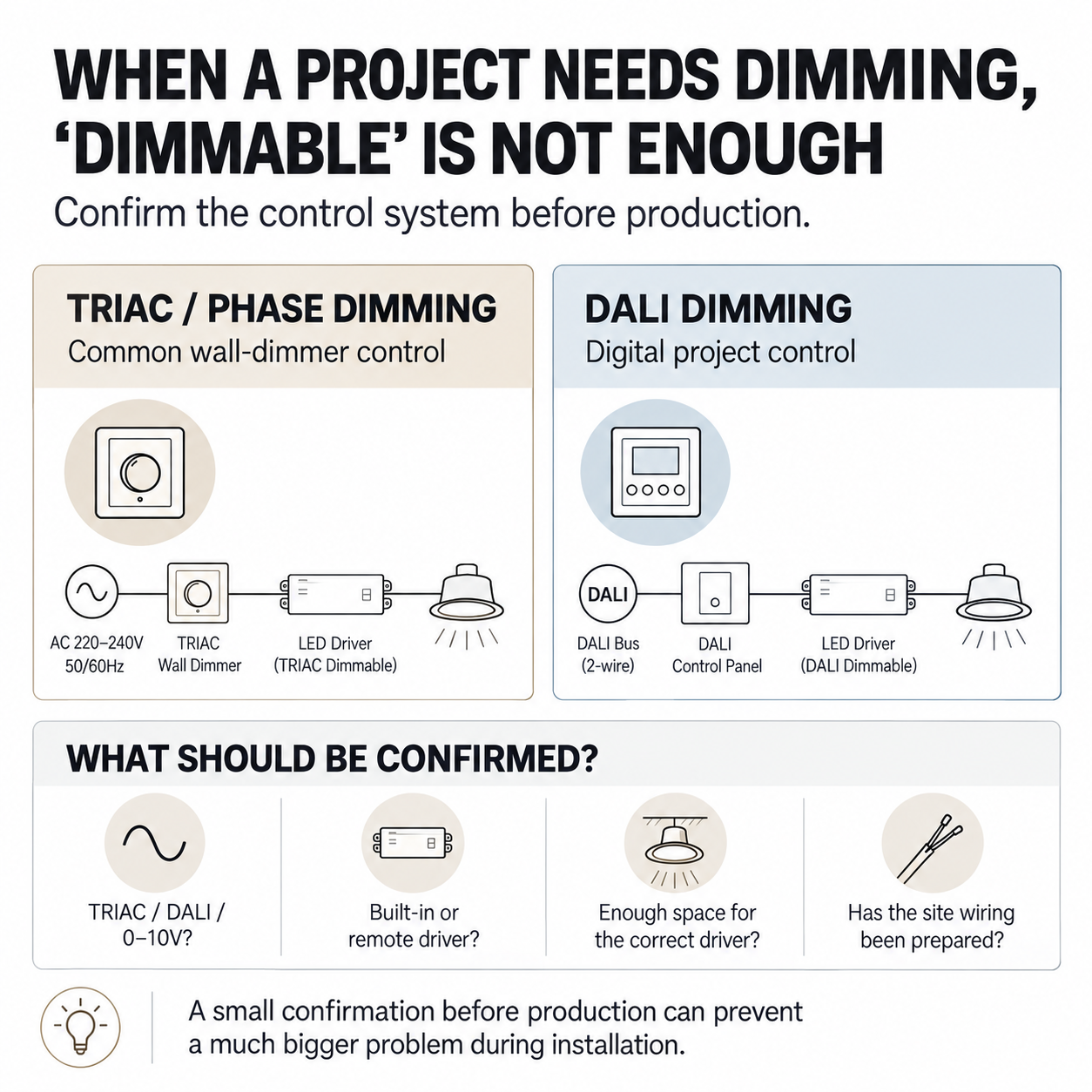
For decorative lighting projects, the word “dimmable” is not always enough information.
It confirms that the light output can be adjusted, but it does not explain which control system the fitting must use, which driver is required or whether the site wiring is compatible.
For a standard residential product, this may be relatively straightforward. For bespoke lighting used in hotels, restaurants and commercial interiors, it needs to be confirmed before production begins.
Different projects use different dimming systems
When a project requires dimming, the default solution offered by many lighting factories in China is often TRIAC or phase dimming.
This can work well with many commonly used wall dimmers, particularly for mains-voltage dimmable LED bulbs or fittings using compatible phase-dimmable drivers.
However, hotel and commercial projects—especially specification-led projects in Europe—may require a different control system.
Depending on the project, the requirement may be:
- TRIAC or phase dimming
- DALI or DALI-2
- 0–10V or 1–10V
- Another project-specific lighting-control system
These systems are not interchangeable simply because they all provide dimming.
The correct driver, control wiring and installation arrangement depend on the system specified for the project.
When is TRIAC dimming commonly used?
TRIAC dimming controls the input power supplied to a compatible lamp or LED driver.
It is often used with a conventional wall dimmer and does not normally require a separate pair of control wires between the dimmer and driver.
For decorative lighting, it may be a practical solution when the fitting uses:
- Dimmable mains-voltage LED bulbs
- A compatible phase-dimmable LED driver
- A standard wall-dimmer arrangement
- A relatively simple local lighting-control system
However, compatibility still needs to be checked.
The lamp, driver and wall dimmer must work together correctly. Otherwise, the fitting may flicker, have a limited dimming range, remain slightly illuminated at the lowest setting or behave inconsistently.
The word “TRIAC” alone does not confirm the final dimming performance.
When might a project require DALI?
Hotels and larger commercial interiors are often controlled through a central lighting-control system rather than an individual wall dimmer.
In these projects, DALI may be specified.
DALI is a digital lighting-control protocol that allows compatible devices to communicate within a lighting system. The fittings may be grouped, addressed, programmed and commissioned as part of the wider project.
A fitting supplied with a TRIAC-dimmable driver cannot simply be connected to a DALI system and expected to operate correctly.
If DALI is required, the fitting needs an appropriate DALI driver, and the site must have the necessary DALI control wiring and control equipment.
The project may also specify DALI-2 rather than simply DALI, so the exact driver requirement should be checked rather than assumed.
What about 0–10V and 1–10V?
Some projects use an analogue 0–10V or 1–10V control system.
These systems require a compatible driver and a separate control connection. The minimum dimming level and switch-off behaviour can vary depending on the selected driver and control equipment.
Once again, “dimmable” does not describe enough.
The specification should confirm the control system, the minimum dimming requirement and whether the fitting is expected to dim completely to off.
What should be confirmed before production?
Before selecting the driver or finalising the construction of a bespoke fitting, several questions should be answered.
1. Which dimming system is required?
Is the project using:
- TRIAC or phase dimming?
- DALI or DALI-2?
- 0–10V or 1–10V?
- Another control system?
If the specification only states “dimmable”, clarification may be needed from the lighting designer, electrical consultant or contractor.
2. Where will the driver be installed?
Will the driver be:
- Built inside the fitting?
- Concealed inside the ceiling canopy?
- Installed remotely above the ceiling?
- Located inside an accessible maintenance area?
The driver position affects the construction of the fitting, cable routing and future maintenance access.
3. Is there enough space for the correct driver?
Different driver types may have different dimensions.
A slim canopy designed around a small TRIAC driver may not have enough space for the DALI driver required by the project.
If the correct driver cannot fit inside the fitting, a remote location or a larger canopy may be necessary.
This should be resolved during the shop-drawing stage rather than after the fixture has been manufactured.
4. Has the site wiring been prepared?
The site wiring must match the selected control system.
A fitting with a DALI driver still requires the correct DALI control wiring and control equipment on site. A 0–10V driver requires the appropriate analogue control connection. A phase-dimmable fitting requires a compatible phase-control arrangement.
Installing the correct driver inside the fitting cannot compensate for missing or incompatible site wiring.
5. Is the complete system compatible?
The fitting, LED source, driver, control system and site wiring need to work together.
Compatibility should not be assumed from the word “dimmable” or from the driver label alone.
The exact driver model and its technical data should be reviewed before production.
The driver can affect the physical design
For bespoke lighting, driver selection is not only an electrical decision.
It can also affect:
- The size and depth of the ceiling canopy
- The internal layout of the fitting
- Ventilation and heat management
- The number of drivers required
- Cable lengths and voltage drop
- Access for replacement and maintenance
- The position of suspension and power-feed points
This is why the control requirement should be confirmed before the production drawing is approved.
If the driver changes after the metalwork or canopy has already been manufactured, the fitting may also need to be modified.
A fitting can look correct but still fail on site
The appearance of a decorative fitting is only one part of the project.
A fixture may match the approved dimensions, materials and finish but still create problems if the driver or control method is incorrect.
The problem may only become visible during installation or commissioning, when the fitting:
- Does not respond to the control system
- Does not dim smoothly
- Flickers at lower levels
- Cannot switch off as required
- Requires a different driver
- Needs additional control wiring
- Does not provide suitable maintenance access
At that stage, changing the driver, modifying the canopy or altering the site wiring can become difficult and expensive.
Why technical coordination matters
For bespoke lighting, the driver, control method, wiring, installation space and site conditions should be reviewed together.
The shop drawing should show the driver location and relevant installation requirements. The driver specification should match the project’s control system. The contractor should understand the power and control wiring required before installation begins.
“Dimmable” should therefore be treated as the start of the discussion, not the complete specification.
A small confirmation before production can prevent a much bigger problem during installation and commissioning.