
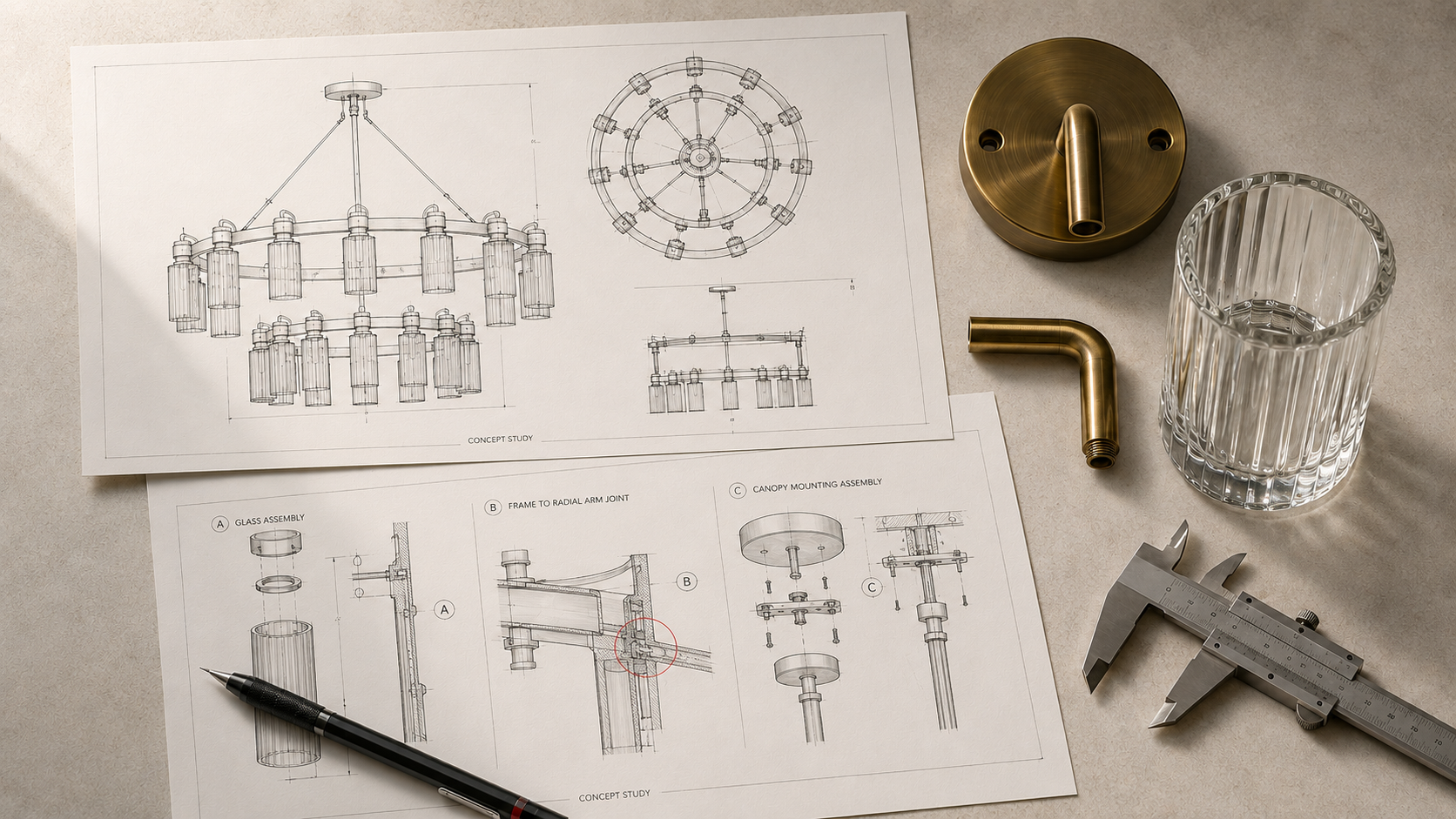
A bespoke lighting project often begins with a sketch, reference image, specification or drawing prepared by an interior designer, architect or lighting consultant. This information establishes the intended appearance of the fixture, but it may not contain every detail required for manufacturing.
Before production can begin, the original design normally needs to be developed into a more detailed set of production shop drawings.
Although design intent drawings and production shop drawings describe the same fixture, they serve different purposes. Understanding the distinction helps designers, manufacturers and contractors coordinate more effectively and identify potential issues before materials are ordered.
What Is a Design Intent Drawing?
A design intent drawing communicates the visual and functional direction of a lighting fixture.
It may include:
- Overall dimensions
- General proportions
- Fixture position
- Preferred materials
- Finish references
- Light source requirements
- Suspension height
- Basic mounting information
- Reference images or renderings
Its primary purpose is to explain what the designer wants to achieve.
A design intent drawing may show that a pendant should have a particular diameter, finish and overall drop, for example. However, it may not explain the internal support, material thickness, fixing method, cable route or driver location.
This does not mean the drawing is incomplete for its intended purpose. It means that further technical development is required before the fixture can be manufactured.
What Is a Production Shop Drawing?
A production shop drawing translates the approved design intent into a fixture that can be manufactured, assembled and installed.
It considers not only how the product should look, but also how each component will work together.
Depending on the design, a production shop drawing may include:
- Confirmed overall dimensions
- Component dimensions
- Material thicknesses
- Internal construction
- Joining and fixing methods
- Suspension components
- Ceiling plate or backplate details
- Cable entry points
- Light-source position
- LED profile or lampholder arrangement
- Driver location and access
- Assembly details
- Installation requirements
- Removable or replaceable components
- Finish references
- Weight and support considerations
The purpose of the production drawing is not to change the design. It is to resolve the technical details required to manufacture it reliably while protecting the original visual intention.
The Main Difference
The simplest way to describe the distinction is:
A design intent drawing explains what the fixture should be. A production shop drawing explains how it will be made.
The design drawing focuses on appearance, scale and function.
The production drawing focuses on construction, coordination and manufacturing feasibility.
Both are important. One should not replace the other.
Without a clear design intent, the manufacturer may not fully understand the visual priorities of the project. Without production development, an attractive concept may contain unresolved structural, electrical or installation issues.
Why a Design Drawing Cannot Always Go Straight into Production
A lighting fixture can appear simple from the outside while containing many interconnected components inside.
A decorative pendant may require coordination between:
- The visible body
- Internal metal support
- Glass or translucent elements
- LED modules or lampholders
- Drivers
- Wiring
- Suspension cables or rods
- Ceiling fixings
- Access for assembly and maintenance
A small change to one component can affect several others.
For example, reducing the size of a ceiling plate may leave insufficient space for the specified driver. Increasing the overall diameter of a chandelier may require additional suspension points. A heavy decorative element may need a concealed support that was not shown in the original concept drawing.
These details are difficult to resolve from appearance alone.
Production drawings allow the manufacturer to review the complete fixture before fabrication begins.
What Should Be Reviewed During Production Development?
Overall dimensions and proportions
The main dimensions should remain consistent with the design intent. However, smaller component dimensions may need to be confirmed according to the selected materials and manufacturing methods.
Any change that affects the visible appearance should be discussed before the drawing is approved.
Materials and finishes
A finish reference such as antique brass, brushed bronze or satin nickel describes the intended appearance, but the final result can also depend on the base material and finishing process.
Production development should confirm which components use stainless steel, brass, aluminium or another suitable material, as different materials may respond differently to polishing, brushing, plating or coating.
Internal structure
Large or complex lighting fixtures may require an internal frame to support decorative elements and distribute weight.
This structure should be strong enough for the fixture while remaining visually discreet. Its position may also affect wiring, light distribution and assembly.
Light source and driver
The drawing should coordinate the specified light source with the available internal space.
For integrated LED fixtures, this may include the LED module, heat management, diffuser, wiring and driver. The driver location must also allow practical installation and future access where required.
Fixing and suspension
The fixing method should reflect the size, weight and installation conditions of the fixture.
A large chandelier may require several suspension points, while a wall light may need a backplate that suits the wall construction and available electrical connection.
The production drawing should show how the fixture connects to the building, rather than displaying only the decorative form.
Assembly and maintenance
A fixture must be possible to assemble without damaging finished surfaces or fragile decorative components.
Where practical, the drawing should also consider how light sources, drivers or diffusers can be accessed after installation.
Packaging and transportation
Large decorative lighting sometimes needs to be manufactured in sections. The division between sections can affect the structure, visible joints, site assembly and packaging dimensions.
These decisions should be considered during production development rather than after the fixture has already been completed.
Production Drawings Should Preserve the Design Intent
Technical development should not become an excuse to simplify or alter the design without approval.
When a manufacturing limitation is identified, the manufacturer should explain:
- What the issue is
- Why it affects production
- Which part of the design is involved
- What solution is proposed
- Whether the proposal changes the visible appearance
This gives the designer or client enough information to make an informed decision.
A technically convenient solution is not automatically the right solution if it changes an important proportion, finish or decorative detail.
The aim is to find a workable construction that remains faithful to the original concept.
What Does Drawing Approval Mean?
Production drawing approval confirms that the developed fixture reflects the agreed design information at that stage.
Before approval, the relevant parties should review details such as:
- Dimensions
- Quantity
- Materials
- Finish
- Light source
- Colour temperature
- Dimming or control requirements
- Fixing method
- Suspension length
- Driver location
- Visible joints
- Installation conditions
Approval provides a clear reference for purchasing materials and beginning production.
However, drawings should still be read together with the approved specification, finish sample and other project documents. A drawing alone may not communicate every aspect of colour, texture or light output.
A Collaborative Process
The most successful bespoke lighting projects usually involve communication between the design team, manufacturer and installer.
The designer protects the visual intention. The manufacturer develops the construction and production details. The installer provides information about the ceiling, wall, electrical supply and site conditions.
When these parties coordinate early, potential problems can be identified before they become costly production or installation issues.
Production shop drawings are therefore more than manufacturing documents. They are an important communication tool between design and production.
From Design Intent to Manufacture
The transition from a design drawing to a production shop drawing is where a lighting concept becomes a buildable product.
A well-developed production drawing should:
- Respect the original design
- Resolve the internal construction
- Coordinate the electrical components
- Clarify assembly and installation
- Reduce uncertainty before production
For bespoke lighting, this stage is essential. It allows creative ideas to be developed into fixtures that can be manufactured, delivered and installed with greater confidence.
Discuss Your Lighting Project
If you have a design drawing, reference image or lighting concept that requires production development, share the available information with us.
We can review the design intent, identify the details that need to be resolved and develop the fixture towards production.