
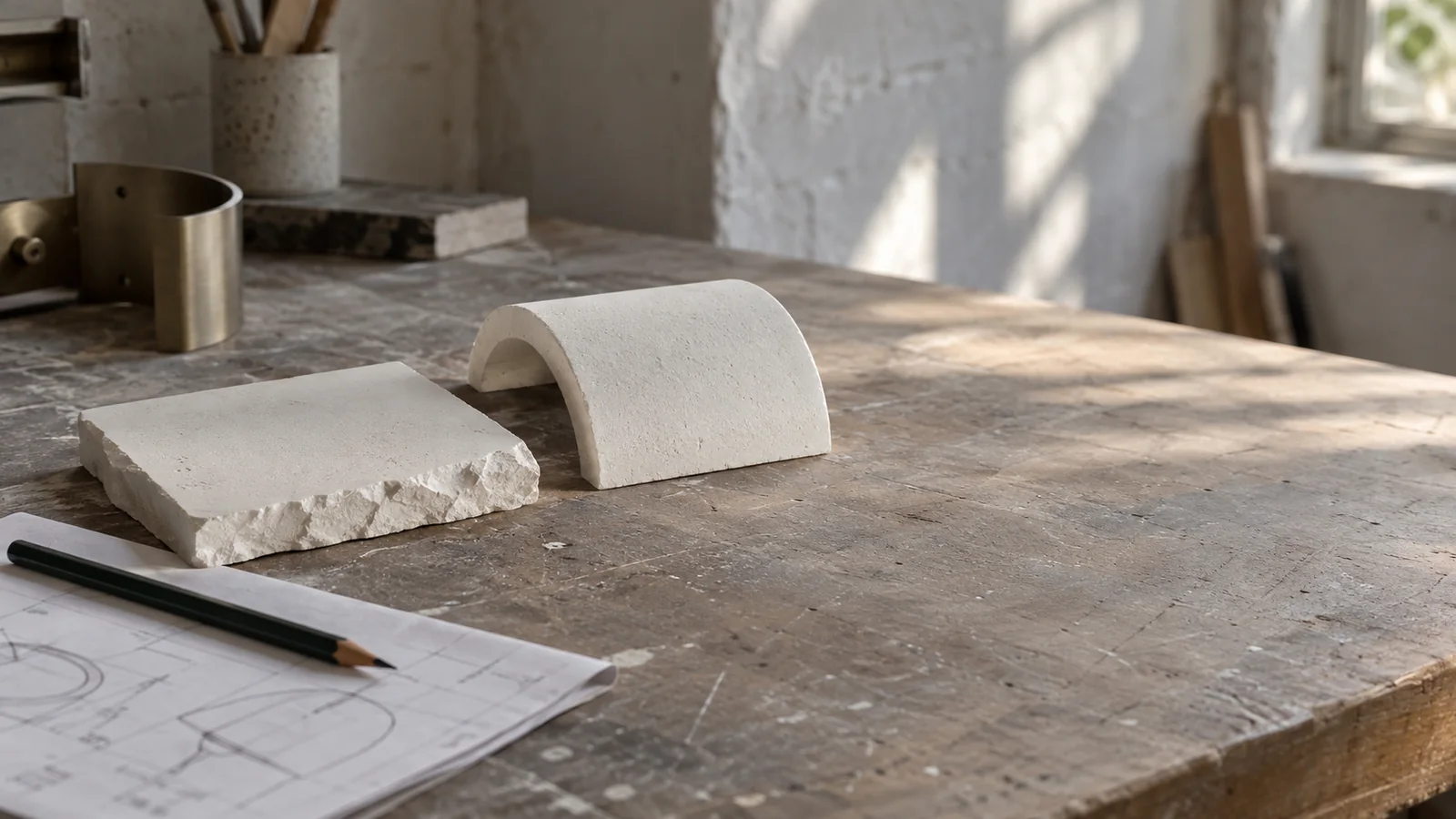
A designer may send us a reference for a sculptural light with a soft, chalky surface and ask whether it can be made in plaster. The first thing we need to understand is what matters most in that reference. Is it the material itself, or the shape and appearance?
In some cases, a cast resin body with a matte, plaster-effect finish is an option. It can give us a similar visual direction, but the two materials should never be described as interchangeable.
Start with the shape
A simple form may be straightforward to produce in plaster. A more detailed shape can raise questions about how the body will be cast, reinforced, joined and fixed to the wall or ceiling.
Resin may offer another way to make the intended form. That does not automatically make it lighter or easier to install. The size, wall thickness, internal support and fixing method still need to be worked out for the actual fitting.
This is especially important for a wall light with a projecting body, or a ceiling fixture whose fixing points must be coordinated with the building.
Look at the sample in person
“Plaster effect” covers a wide range of finishes. One sample may be smooth and almost painted; another may have a more visible mineral texture. They can look alike in a photograph and feel quite different when handled.
If the finish will sit close to a plaster wall, we would want to compare a physical sample with the surrounding material. Colour, texture and sheen all affect whether the light feels at home in the space. It can also be useful to see the finish on a curved part of the fitting, where light falls across the surface differently from a flat sample.
A finish photograph is useful for an initial discussion. For final approval, the actual sample gives everyone a clearer reference.
Check the requirements behind the finish
The selected resin formulation matters. We need to review its suitability for the fixture, including its position relative to the light source, the expected operating temperature and any fire-performance requirements for the project. Those points cannot be settled by the word “resin” alone; they depend on the proposed material and the completed construction.
The same applies to cleaning and handling. A decorative light in a hotel corridor and a table lamp in a guestroom will be touched in different ways. The surface finish needs to suit where the product will be used.
If the design calls for the fixture to become part of a plaster wall or ceiling, genuine plaster may be the better choice. The detail at the edge, the installation method and the intended finish of the surrounding surface all need to be considered together.
Name the material clearly
A resin light can have a convincing plaster-like appearance. The specification should still say what the body is made from and how it is finished.
We would describe the proposed construction as a resin body with a plaster-effect finish, then confirm the sample, fixing details and relevant technical requirements before production. That gives the designer the appearance they are looking for and gives the project team an accurate record of what will be supplied.
Have a plaster-look lighting concept in development? Send us the reference images, dimensions and installation details, and we can review which construction is suitable for the design.