
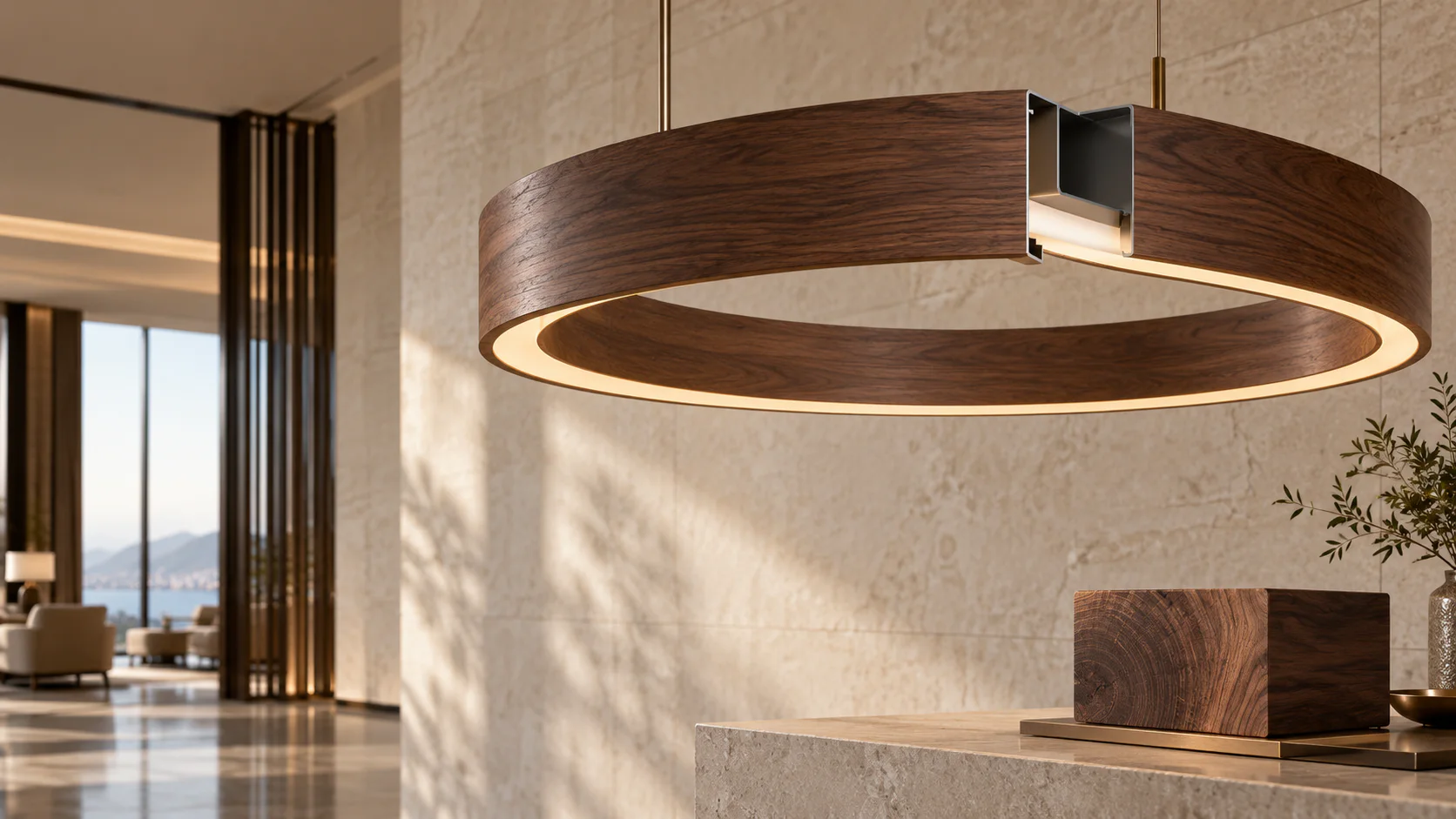
Timber finishes bring warmth and softness to hospitality interiors. They can help a decorative light feel more connected to joinery, furniture and other natural materials within a space.
But when a lighting specification calls for a wood-grain appearance, the structure does not always need to be made from solid timber.
For some bespoke lighting projects, we may recommend using fabricated mild steel with a wood-grain finish. This is not simply a visual imitation or a way to reduce cost. When selected carefully, it can be a practical engineering decision based on the shape of the fitting, its installation environment, the project budget and the destination country.
What is a wood-grain metal finish?
A wood-grain metal finish uses a metal substrate—often mild steel or aluminium—to create the structure of the fitting. A decorative finishing process is then applied to reproduce the colour and grain of timber.
The exact process can vary depending on the metal, the required colour and the supplier. It may involve a powder-coated base with a wood-grain transfer process or another specialist decorative coating system.
From normal viewing distance, a well-produced finish can give the warmth of timber while retaining the structural characteristics of metal. Before production, the colour, grain scale, sheen level and direction of the pattern should all be confirmed with a physical finish sample.
Cost and production considerations
Real timber can require careful material selection, drying, machining, jointing and surface finishing. Cost may also change according to the timber species, grade and availability.
For some designs, particularly those with repeated metal sections or larger quantities, wood-grain mild steel can provide the required visual effect at a lower and more predictable cost.
This does not mean metal is automatically cheaper in every case. Complex forming, welding and finishing can also add cost. The complete construction method needs to be reviewed before making a comparison.
Dimensional stability
Natural timber responds to its environment. Changes in humidity and temperature may cause it to expand, contract, warp or develop small cracks over time.
These characteristics are part of the beauty of a natural material, but they can create challenges in lighting products that depend on consistent dimensions, aligned joints or close-fitting diffusers.
A metal structure is generally more dimensionally stable. This can be useful for long linear fittings, curved frames, large rings and other forms where accurate alignment is important.
Structure and fabrication
Many bespoke decorative lights contain concealed fixings, internal wiring, LED modules, drivers, diffusers and suspension points. The body of the fitting must do more than provide its external appearance—it must also support the complete electrical and mechanical assembly.
Mild steel can be cut, folded, rolled and welded into complex forms. It can also allow slimmer sections and more controlled fixing details than some solid-timber constructions.
For a large decorative fitting, this may make it easier to integrate the lighting system while maintaining the intended shape.
Export and destination requirements
Requirements for natural timber vary between markets and may depend on the timber species, country of origin, level of processing and destination regulations. Some projects may require additional declarations or supporting information for wooden components.
Using a metal substrate can avoid certain timber-specific questions and may simplify export documentation and customs coordination. However, this should always be checked for the actual destination and product; it should not be treated as a universal rule.
Export packaging is a separate issue. If solid-wood crates or pallets are used, the applicable treatment and marking requirements still need to be followed even when the lighting product itself is made from metal.
Electrical integration and maintenance
In decorative lighting, the visible outer finish and the internal engineering must be considered together.
A metal body can provide clear fixing positions for lampholders, LED channels, suspension wires and mounting plates. It can also provide a reliable base for removable covers or access panels where future maintenance is required.
This is especially relevant in hospitality projects, where appearance is important but installation and long-term maintenance cannot be overlooked.
When real timber is the better choice
Wood-grain metal is not a replacement for real timber in every application.
Genuine timber remains the better choice when its natural texture, depth, irregularity and tactile quality are central to the design intent. A close-view decorative table lamp, for example, may benefit more from real timber than a large ceiling feature viewed from several metres away.
Real timber may also be specifically required by the interior designer, architect or brand standard. In these cases, material authenticity is part of the specification and should be respected.
What should be reviewed before deciding?
Before deciding between real timber and wood-grain metal, we normally consider:
- the viewing distance and level of close-up inspection;
- the size, shape and structural requirements of the fitting;
- the required grain colour, direction and sheen;
- the quantity and available budget;
- the installation environment and expected humidity;
- access for wiring, fixing and future maintenance;
- the destination country and relevant import requirements;
- the designer’s intention regarding material authenticity.
A physical finish sample is particularly important. Digital images can help communicate a general direction, but they cannot accurately confirm colour, texture, gloss or the scale of a wood-grain pattern.
The material should work for the complete project
In bespoke lighting, the best material is not determined by appearance alone.
A fitting may look like timber but require the strength, precision and fabrication flexibility of metal. In another project, the character of genuine timber may be essential and worth the additional coordination.
The right decision comes from reviewing the visual intent together with structure, electrical integration, installation, budget, export and long-term performance.
Wood look or real wood—the material should work for the complete project, not only for the first impression.
Our development process reviews material intent alongside construction, lighting integration and production requirements. If you have a fitting in development, you can submit the available project information for review.