
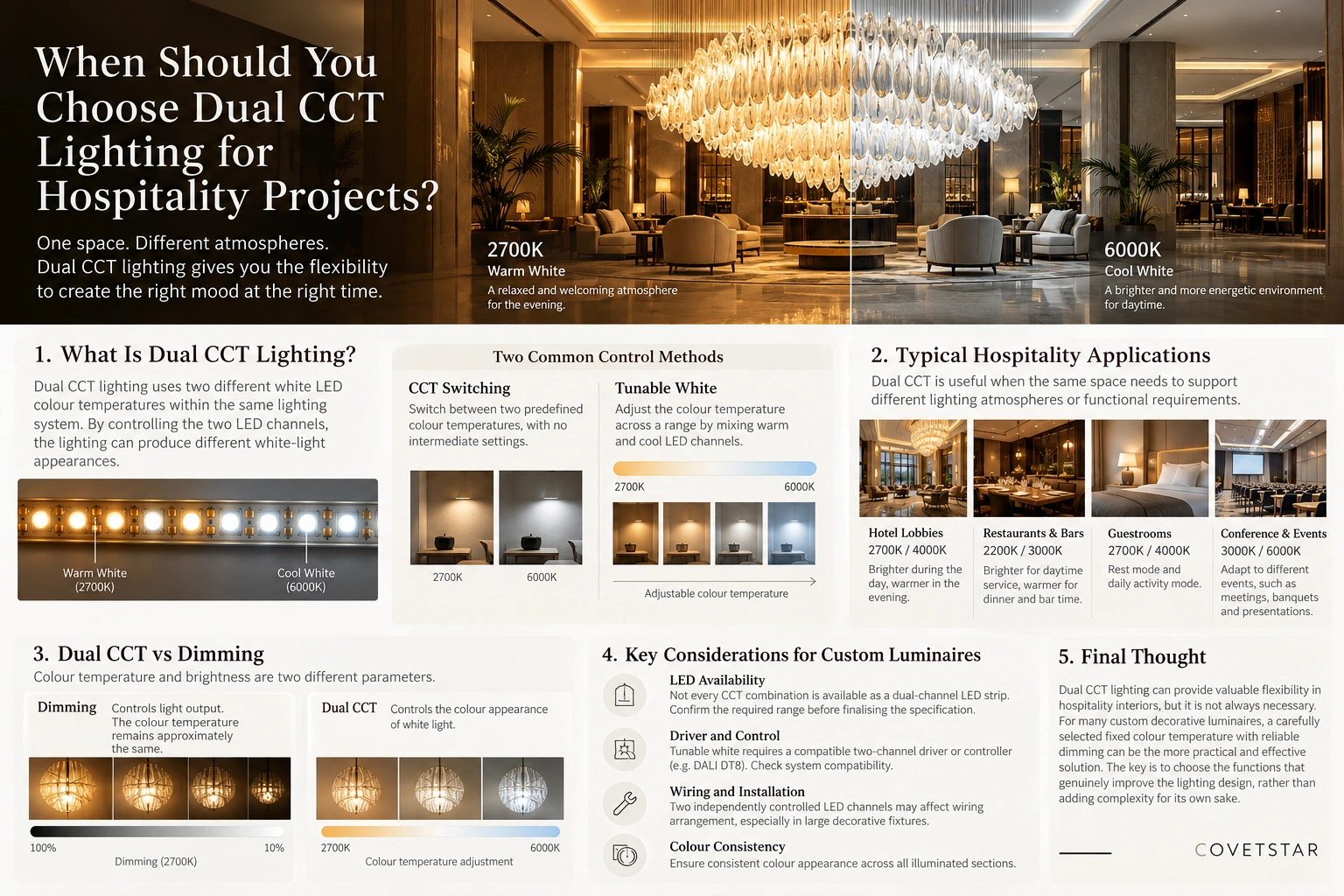
In hospitality lighting, creating the right atmosphere is often just as important as achieving the required illumination level.
A hotel lobby may need to feel bright and welcoming during the day, while a restaurant or lounge may require a softer, warmer atmosphere in the evening.
This sometimes leads designers to specify dual colour temperature (Dual CCT) lighting.
But does every decorative lighting fixture need adjustable colour temperature?
Not necessarily.
For many custom chandeliers, wall lights and decorative pendants, a carefully selected fixed colour temperature combined with reliable dimming may be the more practical solution.
Understanding the difference can help avoid unnecessary complexity in the luminaire design, LED configuration and control system.
1. What Is Dual CCT Lighting?
Dual CCT lighting uses two different white LED colour temperatures within the same lighting system.
For example, an LED module may combine:
- 2700K warm white
- 6000K cool white
By controlling the two LED channels, the lighting system can produce different white-light appearances.
However, there is an important distinction between two types of operation.
CCT Switching
The system switches between two predefined colour temperatures, without necessarily providing intermediate settings.
Tunable White
The system adjusts the relative output of warm and cool LED channels, allowing colour temperature to vary across a designed range.
The achievable colour temperature range, accuracy and consistency depend on the LED configuration and control equipment.
Although these two approaches are sometimes described together as dual-colour lighting, their technical requirements are not identical.
2. When Is Dual CCT Useful in Hospitality Lighting?
The main reason to choose Dual CCT is to allow the same space to support different lighting atmospheres or functional requirements.
Hotel Lobbies and Reception Areas
Hotel lobbies often serve multiple purposes throughout the day.
A brighter, more neutral lighting appearance may be preferred during busy daytime periods, while warmer lighting can create a more relaxed atmosphere in the evening.
If the lighting design specifically requires these changes in colour temperature, tunable white may be appropriate.
However, if the desired difference is mainly brightness, a fixed warm-white LED with dimming may achieve the intended result without additional colour-control equipment.
Restaurants, Bars and Lounges
Restaurants and bars frequently require different lighting scenes for breakfast, lunch and evening service.
For example, a restaurant may prefer a brighter lighting environment during breakfast and a warmer, lower-intensity atmosphere for dinner.
Dual CCT can support these changes when colour temperature is an intentional part of the lighting design.
However, many hospitality interiors are designed around consistent warm lighting, often using 2200K, 2400K, 2700K or 3000K.
In these cases, changing colour temperature may be unnecessary.
A suitable fixed CCT combined with smooth dimming can often provide the required flexibility.
Hotel Guestrooms and Suites
Guestrooms contain different lighting functions, including:
- Bedside reading lights
- Decorative wall lights
- Table lamps
- General ambient lighting
Not all these luminaires need the same control functionality.
A bedside reading light may need a specific brightness and beam distribution, while a decorative wall light may primarily contribute to the room's atmosphere.
Some guestrooms benefit from adjustable white lighting, particularly when one luminaire performs several functions.
In other cases, using separate luminaires with appropriate fixed colour temperatures is simpler and more effective.
Conference and Multipurpose Spaces
Multipurpose spaces are among the stronger applications for tunable-white lighting.
The same room may be used for conferences, presentations, dining or social events.
Adjustable colour temperature and brightness can help the lighting adapt to different activities.
Even then, the specification should distinguish between functional architectural lighting and decorative feature luminaires.
A large chandelier does not necessarily need to change colour temperature simply because the surrounding downlights can.
3. Dual CCT vs Dimming: What Is the Difference?
One of the most common misunderstandings in decorative lighting specifications is the assumption that changing the lighting atmosphere always requires changing colour temperature.
In reality, colour temperature and brightness are two different parameters.
Dimming controls light output.
For example, a 2700K LED can be dimmed from a higher output to a much lower output while maintaining approximately the same colour temperature.
Dual CCT controls the colour appearance of white light.
A tunable-white system can move between warmer and cooler light, subject to its designed CCT range.
These functions can also be combined.
| Requirement | Typical Solution |
|---|---|
| Reduce brightness in the evening | Fixed CCT + dimming |
| Maintain a consistent warm atmosphere | Fixed warm-white CCT |
| Switch between two white-light settings | Dual CCT switching |
| Adjust colour temperature across a range | Tunable white |
| Change brightness and colour temperature independently | Tunable white with compatible dimming control |
For decorative lighting, the first question should therefore be:
Does the project actually need a change in colour temperature, or only a change in brightness?
This distinction can have a significant impact on the electrical design and cost of a custom luminaire.
4. What Changes When Dual CCT Is Used in a Custom Luminaire?
Dual CCT is not simply a matter of choosing two LED colours.
Several technical details need to be considered during the design stage.
LED Strip and Module Availability
A single-colour LED strip may be readily available in 2200K, 2700K, 3000K or 6500K.
However, this does not mean every combination of two colour temperatures is available as a dual-channel LED strip.
For example, a particular supplier may offer 2700K + 6000K or 3000K + 6000K combinations but not a 2200K + 6500K version.
Unusual CCT combinations may require custom LED production, minimum order quantities and additional testing.
Therefore, LED availability should be confirmed before the colour-temperature range is finalised in the lighting specification.
Driver and Control Requirements
Fixed-CCT luminaires normally require a suitable single-channel LED driver or control arrangement.
Tunable-white luminaires require independent control of warm-white and cool-white LED channels.
Depending on the system, this may involve:
- A compatible two-channel LED driver or controller
- Correct constant-voltage or constant-current output
- Appropriate LED channel wiring
- Sufficient driver capacity
- Integration with the building lighting-control system
For DALI installations, DALI DT8 colour type Tc is an established approach for tunable-white control.
However, a driver being described as DALI-compatible does not automatically mean it supports tunable-white colour-temperature adjustment.
Driver functionality and system compatibility should be checked individually.
Wiring and Installation
In a large decorative chandelier, introducing two independently controlled LED channels may affect the wiring arrangement.
This can be particularly important when the luminaire contains multiple illuminated sections, suspension tubes or remote drivers.
The design must account for suitable cable routing, electrical loading, voltage drop and future maintenance access.
These considerations become more significant when the decorative fixture is large or geometrically complex.
Colour Consistency
When multiple LED sections share a tunable-white system, visual consistency is important.
Differences in LED binning, channel output and thermal conditions can result in variations between sections.
For a large feature chandelier, inconsistent white-light appearance may become noticeable across the installation.
LED selection, control calibration and sample testing should therefore be considered before production.
5. Is Dual CCT Always Better for Luxury Hotel Chandeliers?
Not necessarily.
For a large decorative chandelier, the primary lighting design objectives may include:
- Consistent colour temperature across all illuminated elements
- Smooth, stable dimming at low light levels
- Minimal visible LED hotspots
- Appropriate glare control and light distribution
- Reliable driver performance
- Clean integration of electrical components into the fixture
A fixed 2700K or 3000K LED system with properly designed dimming may meet these requirements more effectively than an unnecessarily complex tunable-white arrangement.
This is especially relevant when the chandelier mainly serves as a decorative feature rather than the room's principal functional light source.
There are situations where adjustable colour temperature is justified, but it should be selected for a clear design purpose rather than treated as an automatic upgrade.
6. What Should Be Confirmed Before Specifying Dual CCT?
Before developing a custom luminaire with dual colour temperature, it is useful to establish several details with the lighting designer or project consultant.
First, what is the intended lighting function?
Is the colour-temperature change required for different activities, or is the objective simply to create a softer evening atmosphere?
Second, is switching sufficient, or is continuous adjustment required?
A two-setting system and a continuously adjustable tunable-white system may require different control arrangements.
Third, what colour-temperature range is actually required?
The proposed warm and cool endpoints should be checked against LED module availability and the luminaire's optical requirements.
Fourth, what lighting-control system will be used?
If the project specifies DALI, the designer should confirm whether the required operation is standard intensity dimming or DT8 tunable-white control.
Finally, does every decorative fixture need this function?
In many hotel projects, it may be more practical to use tunable-white architectural lighting alongside fixed-CCT decorative luminaires.
This allows the space to achieve different lighting scenes without adding unnecessary complexity to every custom fixture.
7. Final Considerations
Dual CCT lighting can provide valuable flexibility in hospitality interiors, particularly where a space must support different activities or lighting atmospheres.
However, greater control flexibility does not automatically produce a better lighting design.
For many custom decorative luminaires, the combination of a carefully selected fixed colour temperature, appropriate optical design and reliable dimming can be sufficient.
The decision should be based on how the space will be used, the intended lighting effect and the practical requirements of the luminaire.
The objective is not to provide the maximum number of lighting functions, but to specify the functions that genuinely improve the finished installation.
At Covetstar, we consider LED configuration, driver selection, dimming compatibility and installation requirements during the development of custom decorative lighting for hospitality interiors.