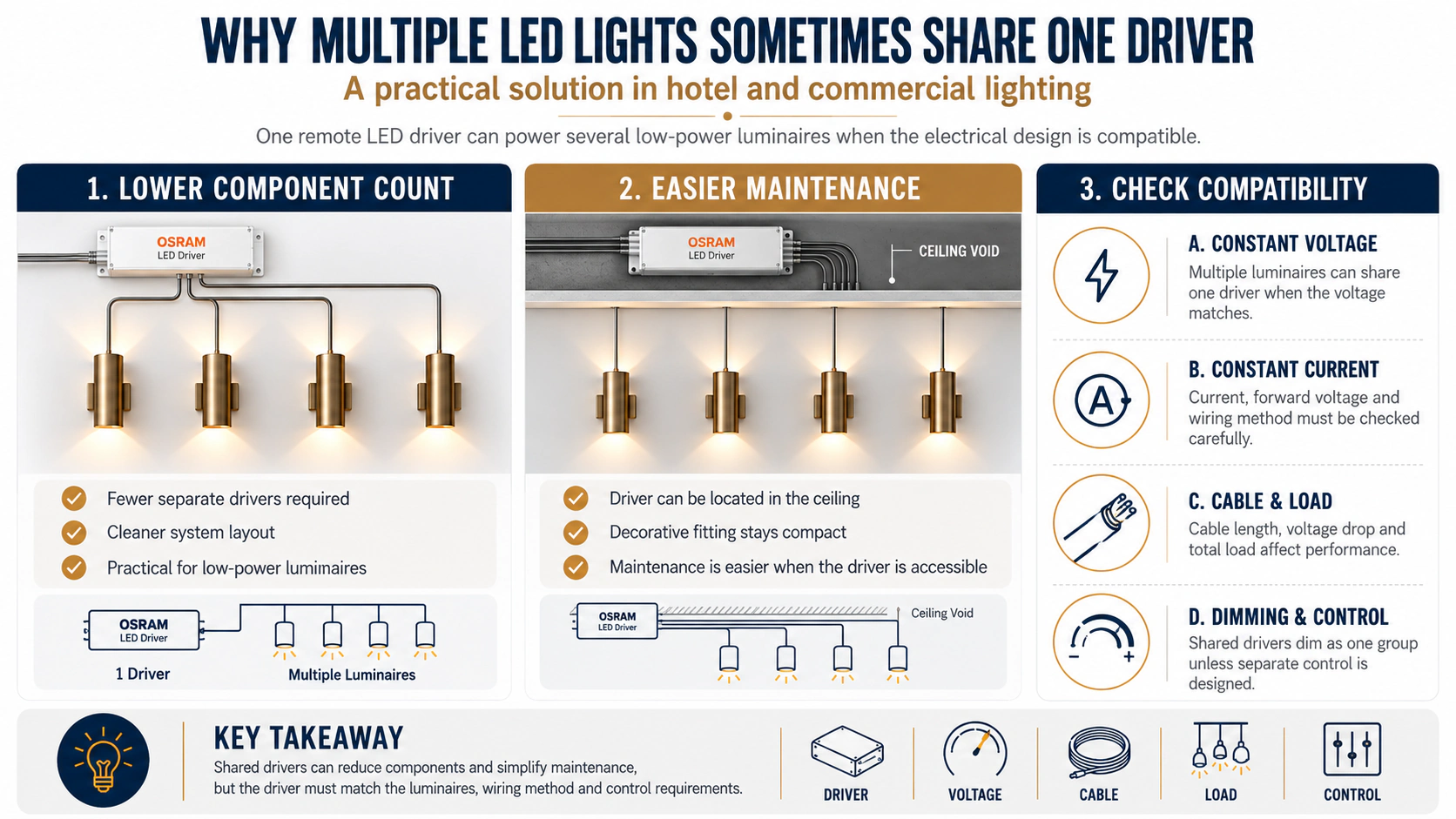
1. Reducing the Number of LED Drivers
One of the most straightforward advantages is reducing the total number of drivers required.
Consider a bathroom with four low-power LED luminaires.
With individual drivers, four separate drivers are needed. With a suitable shared-driver arrangement, all four luminaires may be powered by a single driver.
Across a hotel with many guest rooms, this can significantly reduce the number of electrical components.
It may also reduce material costs and the number of individual driver connections, although the actual installation cost will depend on the wiring layout and accessibility.
Fewer drivers do not automatically mean a better installation, but in some applications, centralising the power supply can be a practical solution.
2. Making Maintenance Easier
LED drivers are electronic components and may require replacement during the lifetime of a lighting installation.
For decorative wall lights, particularly those installed in bathrooms or integrated into interior finishes, replacing an internal driver can be inconvenient.
A remote driver located in an accessible ceiling void allows maintenance personnel to replace the driver without removing the decorative fitting itself.
This is especially useful for:
- Hotel bathroom wall lights
- Bedside reading lights
- Decorative wall sconces
- Low-power architectural lighting
- Custom-made luminaires with limited internal space
However, remote installation is only beneficial when the driver remains accessible for maintenance.
A shared driver also creates a common point of failure. If it fails, all the luminaires connected to it may stop working at the same time.
This trade-off should be considered during the design stage.
3. Improving Driver Selection for Low-Power Luminaires
Many decorative LED fittings consume relatively little power.
For example, four luminaires rated at 3W each have a combined nominal load of 12W.
Instead of using four separate small drivers, a suitable shared driver may be used to power the combined load.
This can be particularly relevant when working with dimmable drivers, some of which have minimum operating load requirements.
However, driver selection should never be based on wattage alone.
The selected driver must also match the required output voltage or current, operate within its specified load range, and support the intended wiring arrangement.
The driver's efficiency, dimming performance and manufacturer requirements should also be considered.
4. Constant Voltage vs Constant Current: An Important Difference
This is where shared-driver arrangements require particular attention.
Not all LED luminaires are designed to operate in the same way.
Constant Voltage (CV)
Constant voltage drivers provide a fixed output voltage, commonly 12V or 24V DC.
For example, several 24V LED luminaires may be connected in parallel to one suitable 24V constant voltage driver.
Each luminaire receives the same nominal supply voltage, while the driver provides the combined current required by the connected load.
Provided the luminaires are designed for this type of supply and the total load remains within the driver's capacity, this arrangement is generally straightforward.
Cable length and voltage drop must still be considered, especially where several luminaires are installed at different distances from the driver.
Constant Current (CC)
Constant current drivers work differently.
They regulate the output current rather than maintaining a fixed output voltage.
For luminaires designed for the same operating current, a series connection may be possible, provided the combined forward voltage falls within the driver's specified output voltage range.
For example, several LED modules rated for 350mA may be connected in series to a suitable 350mA driver.
However, connecting constant current LED modules directly in parallel to a single-output constant current driver can cause uneven current distribution.
Small differences in the electrical characteristics of the LEDs may result in one module receiving more current than another, potentially affecting brightness, temperature and service life.
Where multiple independently controlled outputs are required, a suitable multi-channel driver may be a better option.
The correct wiring method must always follow the specifications of the LED modules and driver manufacturer.
5. Can Different Types of LED Luminaires Share One Driver?
Yes, in some circumstances.
For constant voltage systems, different luminaires can share a driver when they are designed for the same supply voltage and their combined load is within the driver's operating limits.
For constant current systems, the requirements are more restrictive.
The luminaires must have compatible operating currents, and the driver must support the combined electrical load and connection arrangement.
Two luminaires may have similar wattages but require completely different driver outputs.
For example, a 3W luminaire designed for 24V constant voltage operation cannot simply be connected to the same output as a 3W LED module requiring 350mA constant current.
Matching the total wattage does not necessarily mean the luminaires are electrically compatible.
This is an important distinction when developing bespoke lighting for commercial interiors.
6. Why Cable Length Matters
When a driver is installed remotely, the distance between the driver and the luminaires becomes part of the electrical design.
Longer cable runs introduce resistance, which can result in voltage drop.
In a constant voltage system, excessive voltage drop may cause luminaires farther from the driver to appear dimmer or operate less reliably.
The risk depends on several factors, including:
- Cable length and conductor cross-section
- Total current carried by the cable
- Supply voltage
- Number and position of connected luminaires
- Wiring arrangement
For constant current systems, cable resistance also affects the voltage required from the driver, and the total circuit voltage must remain within the driver's operating range.
Cable length should therefore be reviewed before production, rather than decided only during installation.
The driver manufacturer's limits on output cable length, electromagnetic compatibility and installation methods must also be followed.
7. What About Dimming?
Shared drivers can also affect how the lighting is controlled.
When several luminaires share one dimmable driver output, they will generally dim together as one group.
This may be suitable for bathroom lighting or decorative luminaires intended to operate simultaneously.
However, it is not ideal when individual luminaires need independent control.
For example, in a hotel guest room, the bedside reading lights may need to operate independently from the general decorative lighting.
In this situation, separate drivers or a suitable multi-channel control arrangement may be more appropriate.
For DALI or DALI-2 installations, the control system should also be considered during driver selection.
One DALI-controlled driver does not automatically provide independent control of every luminaire connected to its output.
The control requirements should be confirmed before deciding how many drivers are needed.
8. When Is a Shared Driver Not the Best Choice?
Although shared drivers have several advantages, they are not suitable for every application.
Individual drivers may be preferable when:
- Luminaires require independent switching or dimming.
- Different fittings have incompatible electrical specifications.
- The luminaires are installed too far apart.
- One driver failure would affect too many fittings.
- The shared wiring arrangement would complicate installation or maintenance.
In some projects, using separate drivers is actually the simpler and more reliable approach.
The decision should be based on the overall electrical and installation requirements, rather than reducing the number of drivers wherever possible.
9. What Should Be Confirmed Before Manufacturing?
For custom decorative lighting, driver arrangements should be agreed during the technical drawing stage.
Before production, the lighting manufacturer and electrical contractor should confirm:
- Whether the luminaires require constant voltage or constant current.
- The electrical rating of each luminaire.
- The total connected load and driver operating range.
- The proposed series or parallel wiring arrangement.
- Driver location, accessibility and cable lengths.
- Whether the luminaires require individual switching or dimming.
- Any relevant safety, environmental and installation requirements.
This becomes particularly important when different types of decorative luminaires are intended to share a common power supply.
Resolving these details before manufacturing can prevent wiring changes, additional components and installation difficulties on site.
Final Thoughts
Using one LED driver to power multiple luminaires is not simply a cost-saving measure.
When properly designed, it can reduce the number of electrical components, simplify maintenance and provide a practical solution for low-power decorative lighting installations.
However, the success of a shared-driver arrangement depends on electrical compatibility, wiring design, cable length and lighting control requirements.
For hotel and commercial lighting projects, these decisions are best made early, with coordination between the lighting designer, electrical contractor and luminaire manufacturer.
The goal is not to use the fewest drivers possible, but to select the most appropriate and reliable power supply arrangement for the installation.
At Covetstar, we support bespoke decorative lighting projects with technical drawings, LED driver selection and installation coordination, helping designers and contractors turn custom lighting concepts into practical, manufacturable solutions.