
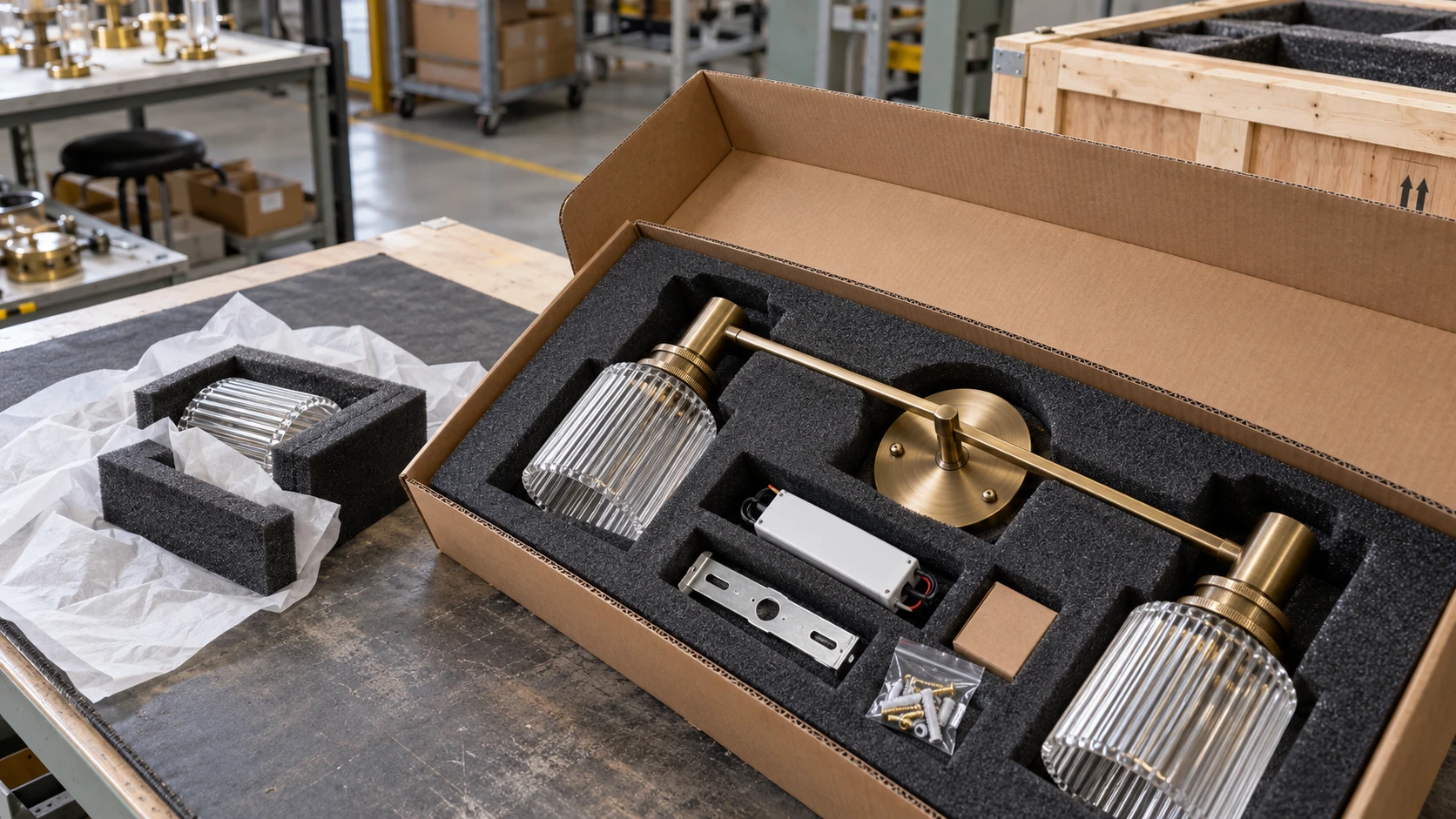
Bespoke lighting may leave the factory in perfect condition, but the project risk does not end when production is complete.
During international shipping, luminaires may be handled several times, transferred between vehicles, stacked in warehouses and exposed to vibration, impact, moisture or incorrect orientation. Decorative glass, stone, metal finishes and projecting components can all be damaged if the packaging is not designed for the actual product.
For hotel, restaurant and residential projects, packaging also affects what happens after delivery. Even when the main fixture arrives undamaged, unclear labels, mixed components or missing installation hardware can create delays on site.
Effective packaging should therefore do more than protect the product. It should support receiving, storage, distribution and installation throughout the project.
Packaging Should Be Designed Around the Luminaire
There is no single packaging method suitable for every bespoke light fitting.
The correct solution depends on factors such as:
- Product dimensions and weight
- Fragility of glass, stone or ceramic components
- Length and shape of projecting arms
- Type of decorative finish
- Number of detachable components
- Shipping method
- Storage conditions
- Installation sequence
- Final project location
A compact wall light and a large decorative chandelier require very different levels of protection. Packaging should be reviewed as part of the product design process rather than added as an afterthought once production is finished.
Separate Fragile Components Where Necessary
Some luminaires are safer to transport when partially disassembled.
Glass shades, crystal components, stone pieces, long arms and decorative accessories may need to be packed separately from the main metal body. This reduces pressure on fragile connections and prevents heavy parts from striking more delicate surfaces during transport.
However, separating components introduces another risk: parts can be mixed up or lost.
Every detached component should therefore be clearly identified and matched to the correct fixture. The outer carton, inner packaging and installation instructions should use a consistent reference system.
For projects containing several similar-looking designs, this becomes especially important.
Protect Decorative Finishes From Contact Damage
Brushed brass, antique bronze, polished nickel and other decorative finishes can be marked even when the carton itself remains undamaged.
Direct contact with rough foam, loose hardware or another metal component may cause scratches, pressure marks or abrasion during transport. Protective materials should be clean, non-abrasive and suitable for the surface being packed.
Finished metal parts can be wrapped individually before being secured within the carton. Small accessories, screws and mounting components should be sealed in separate bags rather than placed loosely beside the luminaire.
Protective films may be appropriate for some surfaces, but they should not leave adhesive residue or react with the finish during long-distance shipping or storage.
Use Custom-Fitted Internal Protection
Empty space inside a carton allows the product to move. Excessively tight packaging can create concentrated pressure on glass or decorative elements.
Custom-fitted foam, moulded inserts or carefully designed partitions can hold the luminaire in position without loading fragile areas. The internal protection should support stronger structural points rather than delicate shades, lampholders or decorative arms.
When reviewing a packaging sample, buyers should check whether the fixture can move inside the carton and whether pressure is being applied to vulnerable components.
The packaging should also remain practical to remove. Installers should not need to pull against fragile parts or damage the finish while unpacking the product.
Consider the Direction of Load and Handling
A carton may not remain upright throughout its journey.
Packages can be tilted, stacked or placed on different faces during loading and unloading. Internal protection should therefore account for forces coming from more than one direction.
Heavy fixtures may require reinforced cartons, timber support or export crates. Long luminaires may need additional structural protection to prevent the packaging from bending. Large chandeliers may require dedicated frames that support the central body while keeping decorative arms and hanging components free from pressure.
Handling symbols can help, but the packaging should not rely entirely on every operator following the markings correctly.
Give Glass and Natural Materials Additional Protection
Glass is one of the most vulnerable elements in decorative lighting.
Each glass component should be protected from direct contact with other parts. Where several glass pieces are packed in the same carton, partitions or individual compartments can prevent collisions.
Handmade glass may include small variations in thickness, shape, colour or texture. Packaging should accommodate these variations rather than applying pressure based on one exact dimension.
Stone, alabaster and ceramic elements also require careful support. Although they may appear substantial, they can chip or crack at edges, fixing points and thinner sections. Heavy natural materials should not be able to shift inside the package and strike nearby components.
Keep Drivers and Electrical Components Secure
Remote drivers, transformers, control modules and connection accessories should be protected and clearly identified.
If a project uses different driver specifications or dimming systems, mixed packaging can lead to incorrect installation. Each electrical component should be matched to the appropriate luminaire or room reference.
Where a driver is packed separately from the fitting, its location should be clearly stated on the carton or packing list. Electrical parts should also be protected from impact, moisture and loose metal hardware.
The information on the product label, driver label and project documentation should remain consistent.
Include All Installation Hardware
A complete luminaire is not ready for installation if the required hardware is missing.
Before sealing the carton, the manufacturer should confirm that the correct items have been included. Depending on the product, these may include:
- Mounting brackets
- Suspension cables or rods
- Ceiling canopies
- Screws and decorative nuts
- Connectors
- Drivers or transformers
- Lamps, where included in the specification
- Special installation tools
- Assembly instructions
Hardware should be contained in a clearly labelled bag or small box. It should not be left loose inside the main package.
For large projects, including a simple component checklist can help the receiving or installation team confirm that everything is present before work begins.
Label Cartons for Project Distribution
Project packaging should help the site team identify where every product belongs.
Useful carton information may include:
- Project name
- Product reference
- Purchase order reference
- Room, floor or area reference
- Quantity
- Carton number
- Gross and net weight
- Package dimensions
- Handling instructions
Room-based or area-based labelling can be particularly valuable for hotel projects. It reduces the need to open several cartons just to find the correct fixture and helps prevent products from being delivered to the wrong installation area.
Labels should be easy to read and securely attached. If information is only written on a removable outer wrap, it may be lost before the product reaches the installation team.
Plan for Storage Before Installation
Bespoke lighting is not always installed immediately after delivery.
Products may remain in a warehouse or on site while other construction work continues. Packaging should therefore be suitable for the expected storage period and environment.
Exposure to moisture, dust or construction debris can damage metal finishes and electrical components. Cartons should be kept dry and stored according to their handling instructions. Heavy packages should not be placed on top of cartons containing fragile shades or projecting components.
If timber cases are used, the project team should also consider access, disposal and any import requirements that may apply to the packaging material.
Review Packaging With a Sample
For complex, fragile or high-value products, packaging should be reviewed before the full order is dispatched.
A sample packing arrangement can help confirm:
- How the fixture is supported
- Which parts are removed
- How decorative finishes are protected
- Where accessories are located
- How the carton is labelled
- Whether the product can be unpacked safely
- Whether the packaging is practical for site distribution
Photographs of the packed product and each packaging layer can provide a useful reference for the buyer. They can also help installers understand how components are arranged before opening the carton.
Where required by the project, transport or drop testing can be discussed according to the product, packaging design and shipping conditions.
Ask for a Packing List and Inspection Record
The final packing list should match the actual shipment.
It should state the number of cartons or cases, the contents of each package and the relevant product references. For projects with separate glass, drivers or installation accessories, these items should be easy to locate within the documentation.
Packing photographs and final inspection records can provide additional reassurance before the goods leave the factory.
These records do not replace good packaging, but they make it easier to investigate shortages or damage if a problem is discovered after delivery.
Provide Spare Parts Where Appropriate
Some projects benefit from including a small quantity of spare components.
The appropriate spares depend on the design, installation conditions and project requirements. They may include extra glass pieces, decorative fasteners, suspension components or other parts that would be difficult to replace quickly.
Spare parts should be clearly labelled and listed separately. They should not be mistaken for unallocated components or installed accidentally in the wrong location.
The requirement for spares is best agreed before production is completed.
Good Packaging Reduces More Than Breakage
The purpose of packaging is not simply to produce an undamaged carton.
A well-designed packaging system protects the finish, keeps components complete, supports project organisation and makes installation more efficient. It considers the full journey from the manufacturer’s inspection area to the final room or installation position.
For bespoke lighting projects, buyers should discuss packaging before shipment and confirm how fragile parts, hardware, electrical components and carton labels will be managed.
At Covetstar, packaging is reviewed according to the construction, materials and delivery requirements of each bespoke lighting product. Contact us to discuss your project specifications, quality-control requirements and international shipping arrangements.