
For hotel and commercial lighting projects, specifying “DALI dimming” is sometimes still not enough.
One detail that is often missed is whether the project requires DALI or DALI-2.
They may sound similar, but they are not exactly the same—and the difference can affect driver selection, system compatibility, installation and commissioning.
What is DALI?
DALI stands for Digital Addressable Lighting Interface.
It is a standardized digital communication protocol used to control lighting systems. Unlike a simple wall dimmer, a DALI system allows compatible lighting devices to communicate with a central control system.
It is widely used in hotels, offices, retail spaces and other commercial interiors where multiple luminaires need to be controlled, grouped or commissioned as part of a larger system.
What is DALI-2?
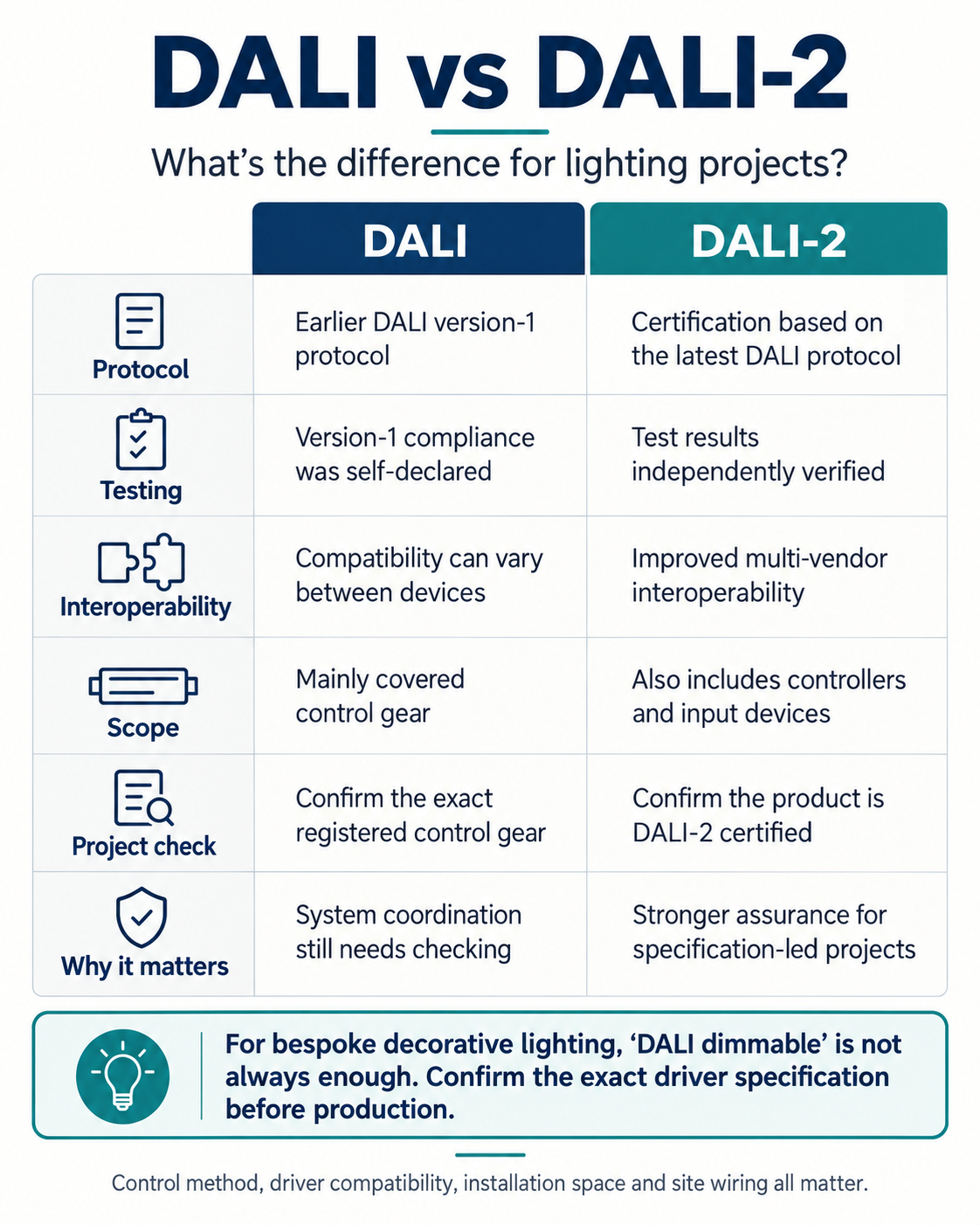
DALI-2 is the certification program based on the latest version of the DALI protocol.
Compared with the earlier DALI version-1 system, DALI-2 introduces more detailed testing requirements, independent verification of test results and a stronger focus on interoperability between products from different manufacturers.
DALI version-1 mainly covered control gear such as LED drivers.
DALI-2 extends the certification system to include other parts of the lighting-control system, including application controllers, input devices and sensors.
This does not mean that every product described as “DALI” is unsuitable. It means that the exact project requirement and the certification status of the proposed equipment need to be checked.
Why does this matter for bespoke decorative lighting?
For bespoke decorative lighting, the LED driver is not always a standard component that can be selected at the end of the project.
Its dimensions, wattage, output type, dimming protocol and installation position may all affect the construction of the fixture.
A driver may need to be:
- Built inside the fitting
- Concealed inside a small ceiling canopy
- Installed remotely above the ceiling
- Divided into several drivers because of the total wattage
- Positioned somewhere accessible for future maintenance
If the project requires a specific DALI-2 driver, that requirement needs to be confirmed before the fitting is manufactured.
The correct driver may be physically larger than another model. It may require a different arrangement inside the canopy, a different remote enclosure or additional access space.
This is why the control requirement cannot be separated from the physical design of the luminaire.
What should be confirmed before production?
A fitting may be described simply as “DALI dimmable”, but several details still need to be reviewed.
1. Does the project require DALI or DALI-2?
The lighting specification or control schedule should state the required system.
If the documents only say “DALI”, the requirement may need to be clarified with the lighting designer, electrical consultant or controls specialist.
2. Is the proposed driver DALI-2 certified?
A driver described as DALI-compatible is not automatically DALI-2 certified.
The exact manufacturer and driver model should be checked. DALI-2-certified products should be listed in the DALI Alliance Product Database.
3. Is the driver compatible with the site control system?
Certification improves interoperability, but the complete system still needs to be coordinated.
The proposed driver, controller and other system devices should be suitable for the project’s control arrangement.
4. Will the driver be built in or installed remotely?
This affects the construction of the fitting, the size of the canopy, cable distances and maintenance access.
For slim decorative pendants, wall lights or large feature chandeliers, there may not be enough internal space for the required driver.
5. Is there enough installation space?
The correct driver needs sufficient physical space, ventilation and access.
This should be considered in the shop drawing rather than left until installation.
6. Has the site wiring been prepared correctly?
The contractor needs to allow for the required mains supply and DALI control wiring.
If the control wiring has not been prepared, selecting a DALI or DALI-2 driver inside the fitting will not solve the site issue.
What can happen if the wrong driver is used?
The fixture may still switch on, which can make the problem less obvious during an early test.
However, difficulties may appear later during commissioning. These could include:
- Inconsistent dimming performance
- Communication problems
- Devices not being recognized correctly
- Compatibility issues with the site control system
- Additional work during programming or commissioning
- Driver replacement or rewiring after installation
For a small fitting, replacing a driver may be relatively straightforward.
For a large chandelier, a group of hotel-room fittings or a driver concealed above a finished ceiling, the same change can become much more difficult and expensive.
“DALI dimmable” is not a complete specification
For bespoke decorative lighting, DALI should not be treated as a simple checkbox.
The exact control requirement needs to be reviewed together with:
- The driver specification
- The LED load
- The shop drawing
- The available installation space
- The driver location
- Maintenance access
- The site control system
- The site wiring
These details are connected.
Changing the driver can affect the dimensions and construction of the fitting. Changing the driver location can affect cable routing and voltage drop. Changing the site control requirement can affect both the electrical design and the installation method.
A small clarification can prevent a larger problem
The most useful question is not simply:
“Is the fitting DALI dimmable?”
The better questions are:
“Does the project require DALI or DALI-2?”
“Which driver will be used, and is it compatible with the complete site system?”
Confirming these details before manufacturing can prevent a much larger issue during installation and commissioning.