
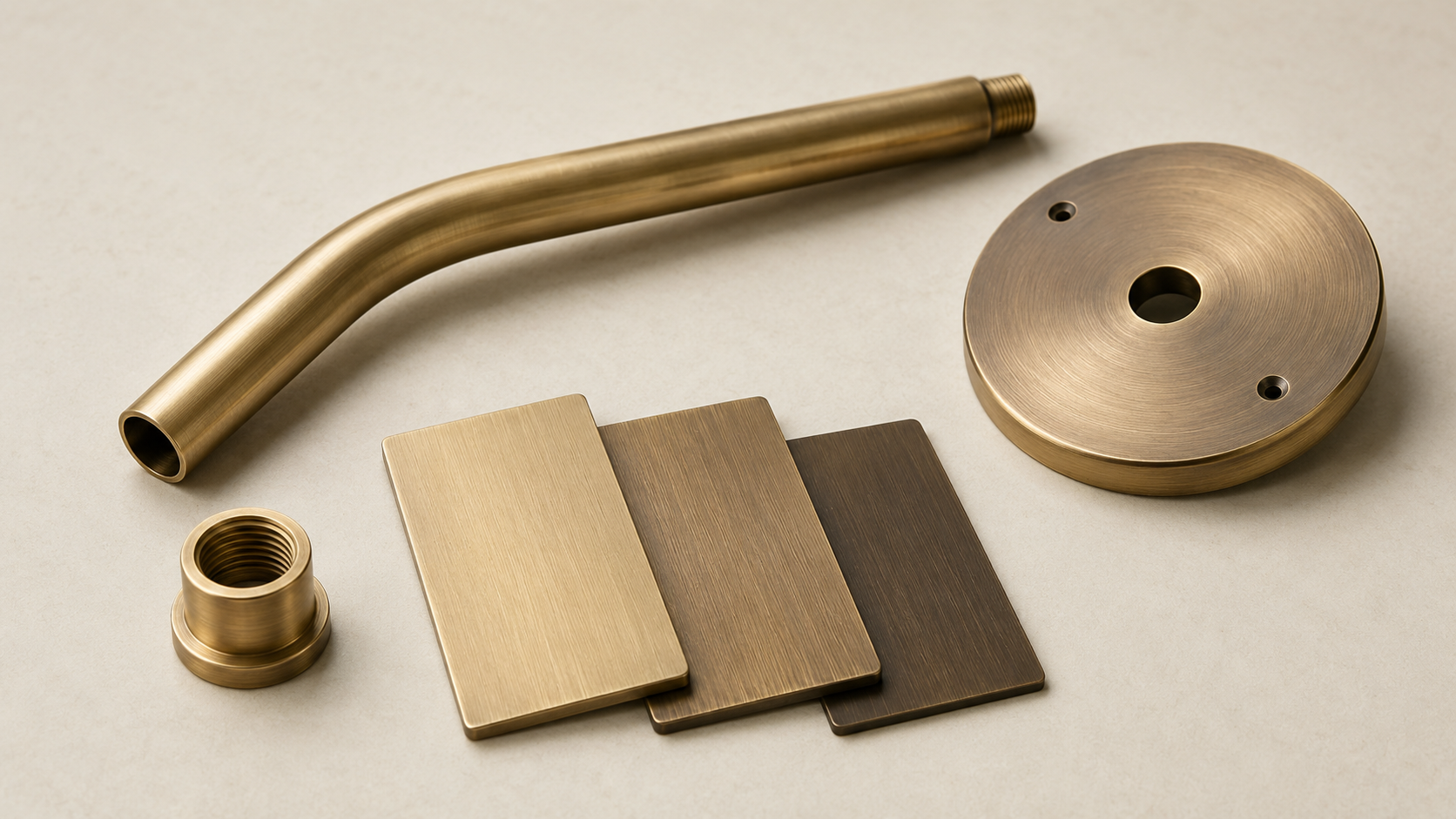
For bespoke lighting, a finish name establishes a direction. Physical samples help define the colour, texture and sheen that the project actually requires.
“Antique brass” may appear to be a clear instruction on a lighting schedule. Yet it leaves several important questions that should be clarified.
Should the finish be light and golden, or darker with a brown undertone? Should the brushing be visible? How much contrast should appear around edges and recesses? Should the surface have a soft sheen or a more reflective appearance?
These differences become particularly noticeable when a fitting brings together several metal components—or when lighting needs to coordinate with nearby furniture, door hardware and architectural metalwork.
A useful finish specification therefore needs to describe more than a colour name.
Start with the appearance, not just the name
Terms such as antique brass, aged bronze and brushed gold communicate a general visual intention. They do not, by themselves, establish an identical result across different suppliers or finishing processes.
For a lighting fixture, the appearance usually needs to be considered through several separate characteristics:
- Colour: the overall tone, including whether it appears more yellow, brown, red or neutral.
- Texture: the visibility, direction and character of brushing or other surface treatment.
- Sheen: how strongly the surface reflects light.
- Antiquing: the depth of the aged effect and the contrast between lighter and darker areas.
Two samples can have a similar colour but still look quite different because one is finely brushed and softly reflective, while the other has stronger texture and more pronounced darkening.
Discussing these characteristics separately makes feedback more useful than simply asking for a finish to be “more antique”.
A reference photograph is a starting point
Photographs are useful for communicating the intended direction, especially during an early enquiry. They are less reliable as the sole basis for final finish approval.
Lighting, exposure, white balance and screen settings can change how a metal surface appears. Reflections from nearby materials also affect what the camera records.
A curved brass-coloured tube may show a bright highlight along one side and a much darker tone along the other, even when the finish itself is consistent.
Where the finish is important to the interior scheme, a physical sample provides a more useful reference. It can be viewed from different angles and compared directly with the surrounding material samples.
If the lighting needs to coordinate with another supplier’s metalwork, identify the actual sample to be matched rather than relying only on that supplier’s finish name.
Review the finish on representative components
A flat finish chip is helpful, but it cannot show every aspect of a completed fitting.
Consider a wall light with a circular backplate, a curved arm and a small machined joint. Even with the same intended finish, these components reflect light differently because their shapes and surface details differ.
A flat sample may establish the colour direction without fully showing how visible brushing will look around the backplate or how an aged effect will read on the joint.
For a finish-sensitive design, it can therefore be useful to review a sample on a representative tube, plate or decorative component. Where several visibly different parts meet, an assembled sample may provide the clearest basis for approval.
The purpose is not to make every surface look identical from every angle. It is to confirm that the parts work together as one fitting.
Confirm the base materials as well
An antique brass appearance does not necessarily mean that the entire fixture is made from solid brass.
A bespoke fitting may combine different materials or construction methods according to its structure, weight, cost and application. Those choices affect the available finishing processes and should be discussed before the appearance is approved.
If a lamp has a stainless-steel stem and a steel base, for example, the requirement for a coordinated finish should be reviewed across both components. Approval of one material should not automatically be treated as approval of the other.
A clear specification distinguishes between the base material and the visible finish. Both matter.
Decide whether the finish should change with time
The intended appearance at delivery is only part of the discussion.
An unlacquered brass finish can develop a patina through exposure and handling. A protective lacquer is intended to help preserve the initial appearance, but it does not make the surface immune to damage or remove the need for appropriate care.
For hospitality lighting, it is worth considering whether the fitting will be frequently touched, where it will be installed and how it will be cleaned.
A bedside reading light and a chandelier suspended above a lobby may have very different levels of handling.
Confirm whether the selected finish is lacquered or unlacquered, whether ageing is expected, and what care guidance applies. These details should accompany the visual approval rather than being left until after installation.
Make sample approval specific
Before production, a practical finish approval record should identify:
- The approved sample reference and revision.
- The components and base materials it applies to.
- The agreed colour, texture and sheen.
- The intended level of antiquing.
- Any protective coating.
- Any acceptable variation and relevant care requirements.
For a hand-applied finish, one sample may not communicate the full acceptable range. Where necessary, agree additional samples showing the lighter and darker limits.
Keep the approved reference available for production review. Photographs can support the record, but should not silently replace the physical sample where one has been agreed.
Importantly, acceptable variation does not mean that scratches, damaged coatings or inconsistent preparation should be accepted as part of an antique appearance.
A finish is part of the complete fitting
In bespoke lighting, metalwork is not simply a support for the light source. Its surface contributes to the character of the whole product.
The most useful finish discussions connect the visual intention with the actual materials, component shapes and conditions of use.
“Antique brass” is a useful place to begin. An agreed sample and a clear approval record provide a much stronger basis for production.
Planning a bespoke lighting project?
Share your drawings, finish references or material samples with Covetstar so the intended appearance can be considered alongside the development of the fitting.
Reviewing finishes across a collection
Explore custom wall lights, table lamps and a coordinated decorative lighting project. Review the finish against the actual component geometry and neighbouring materials, rather than the finish name alone.